 editoradmin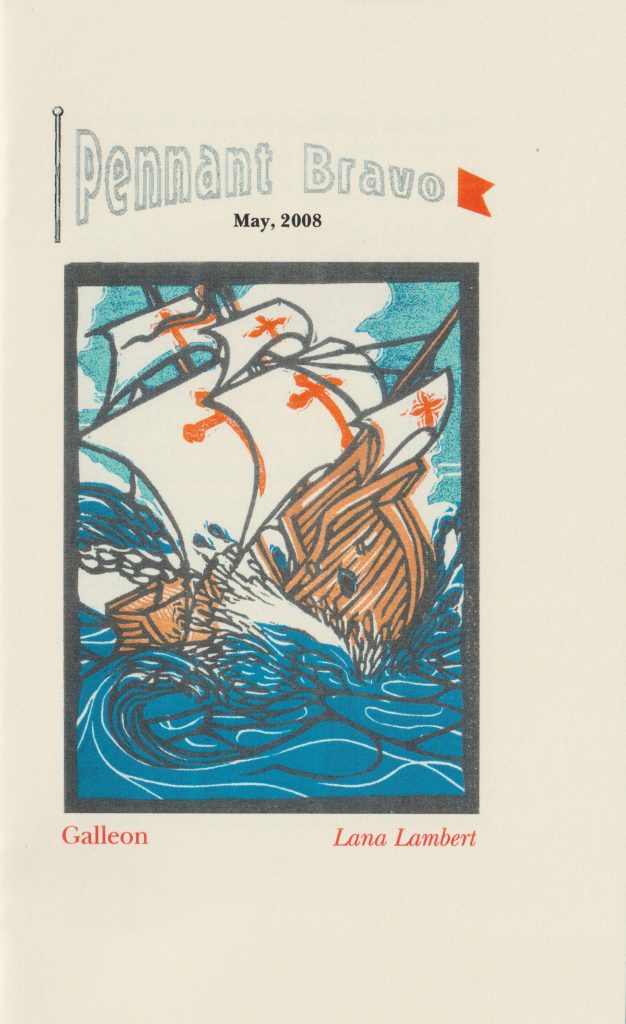
< Pennant Bravo, April 2008 | Pennant Bravo, May 2009 >
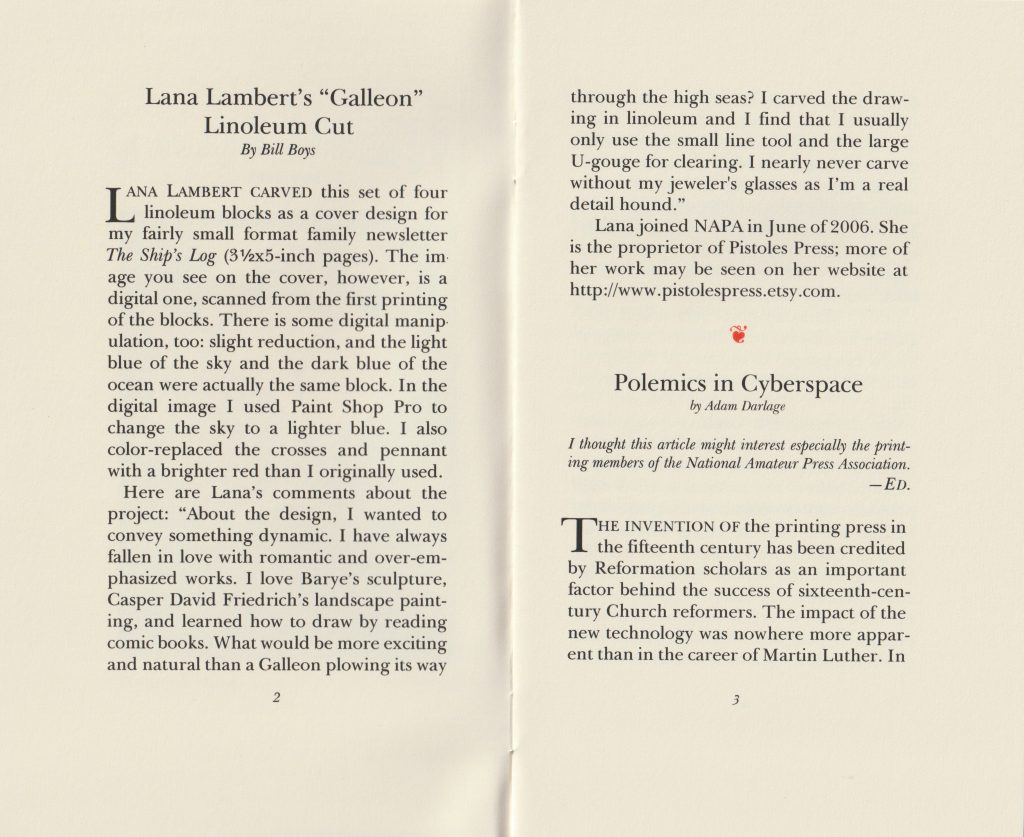
Lana Lambert’s “Galleon” Linoleum Cut
by Bill Boys
LANA LAMBERT CARVED this set of four linoleum blocks as a cover design for my fairly small format family newsletter The Ship’s Log (3½x5-inch pages). The image you see on the cover, however, is a digital one, scanned from the first printing of the blocks. There is some digital manipulation, too: slight reduction, and the light blue of the sky and the dark blue of the ocean were actually the same block. In the digital image I used Paint Shop Pro to change the sky to a lighter blue. I also color-replaced the crosses and pennant with a brighter red than I originally used.
Here are Lana’s comments about the project: “About the design, I wanted to convey something dynamic. I have always fallen in love with romantic and over-emphasized works. I love Barye’s sculpture, Casper David Friedrich’s landscape painting, and learned how to draw by reading comic books. What would be more exciting and natural than a Galleon plowing its way through the high seas? I carved the drawing in linoleum and I find that I usually only use the small line tool and the large U-gouge for clearing. I nearly never carve without my jeweler’s glasses as I’m a real detail hound.”
Lana joined NAPA in June of 2006. She is the proprietor of Pistoles Press; more of her work may be seen on her website at https://lanalambert.com.
Polemics in Cyberspace
by Adam Darlage
I thought this article might interest especially the printing members of the National Amateur Press Association. – Ed.
The invention of the printing press in the fifteenth century has been credited by Reformation scholars as an important factor behind the success of sixteenth-century Church reformers. The impact of the new technology was nowhere more apparent than in the career of Martin Luther. In the aftermath of the indulgence controversy of 1517 that ultimately led to his rejection of Roman authority, Luther published numerous tracts that flew across the Holy Roman Empire during his lifetime and beyond (pamphlets, or Flugschriften, were literally “flying writings”). Surpassed only by publications of the Bible, prints and reprints of Luther’s writings dominated book markets throughout the sixteenth century. Mark Edwards has noted that Luther’s followers were the first to stage a “media campaign” in support of their position through the new technology of printing.
As the sixteenth century progressed and emerging confessional divisions between Protestants and Catholics became more polarized, the markets swelled with polemics and propaganda from all sides. Luther was a favorite target of Catholic controversialists who alleged that besides holding heretical beliefs, he was immoral and rebellious. For starters, he broke his monastic vows, deflowered a nun, and promoted polygamy. This literature was characterized by personal attacks as well as scapegoating and harsh satire. Many Catholic controversialists quoted conflicting statements of Luther on doctrinal or moral matters, or took some of his more famous sound-bites out of context to demonstrate the danger he posed to the Church. “Sin boldly!” was a favorite choice.
Controversial literature still swirls around Luther and his followers, despite the rise of a more objective study of the Reformation in the academy. The internet has made it easier (and cheaper) than ever to respond to current events in a matter of minutes, often with sensational claims and assaults. Reporter Richard Owen, in an article in the March 6th London Times, claimed that Pope Benedict XVI will issue a statement in September that Martin Luther was not a heretic – in other words, “rehabilitate” him. Despite statements from Vatican insiders that such rumors are groundless, the article immediately provoked a firestorm of online controversy among Lutheran and Catholic bloggers who believe that such a move would minimize or trivialize what they believe are important differences between their churches.
Even the most basic theological questions at issue between the two groups since the sixteenth century are still hotly debated online, despite the 1999 signing of the Joint Declaration on the Doctrine of Justification by members of the Roman Catholic Church and the Lutheran World Federation (or perhaps because of it: among both Catholics and Lutherans, some lament this document even as others praise the ecumenical intentions of its drafters). While many argue these questions with respect, decorum, and a good working knowledge of the issues at stake, others fall back on the more hostile strategies used by their sixteenth-century predecessors. They abandon reasoned debate for the same attack and counter-attack format followed by the polemicists of the Reformation era as though centuries of more civil relations between Catholics and Lutherans had not intervened.
Members of the different Reformation churches used the printing press to spread polemics and propaganda as part of a process of identity-formation among people looking for certainty in a suddenly uncertain world. The proliferation of such literature on the internet today may serve a similar purpose for people looking for meaning in an increasingly global and pluralistic society. Indeed, for all the ugliness of polemics and propaganda, this kind of controversial literature was an effective means to bind religious communities together against perceived enemies and outsiders during the Reformation era. As in the sixteenth century, the goal of this literature today is not primarily the conversion of the reader (although this is often a desired result), but rather affirmation of the views shared between authors and their religious communities.
Like the controversial literature of the past, the titles of these blogs and websites are a good indication that they are directed at readers of like mind. The Lutheran Knot of Doubt and Seven-headed Luther are titles of works from the sixteenth century, but could just as easily headline some of the more controversial websites floating around in cyberspace today. To be sure, the deployment of print, radio, and television in the service of religious agendas reminds us that religious controversialists work through a number of different media. But as more and more people get their information online instead of in printed sources, the proliferation of religious polemic and propaganda on the internet is worth watching carefully.
Adam Darlage is a Ph.D. candidate in the History of Christianity at the University of Chicago Divinity School, and a Martin Marty Center Junior Fellow. This article originally appeared electronically as the April 10, 2008, issue of Sightings, which originates the the Martin Marty Center at the University of Chicago, and is reprinted with permission. Their website is https://martycenter.org.
“Facing Reality”
by Bill Boys
“Facing Reality” is the title and “Content shift on way” is the subtitle of an article by Daniel J. Lehmann, editor of my church body’s magazine, The Lutheran.
The magazine recently polled its readers for basic demographic details and Lehmann reports: “The results, while not a complete surprise, were still a bit breath taking.”
Among the statistics reported:
Median age of its readers = 64.
Percent living in small towns/cities and rural areas = 65%.
Percent of readers under age 50 = 18%.
Lehmann continues, “Our faithful followers are aging and we’re not picking up new readers in areas of population growth. Don’t misunderstand: this older segment of subscribers has been incredibly generous and supportive of the ELCA [Evangelical Lutheran Church in America] and the magazine, The Lutheran, won’t turn its back on this generation.”
It struck me that one could say and write almost the same thing about our Association, except maybe we have an even smaller percentage of members under age 50. But we would not want to turn our backs on our members, either.
The Lutheran has an advisory committee of nine people from across the country with journalism backgrounds, and they are elected by the ELCA Church Council, not by the editor or staff of the magazine. “With their input,” Lehmann writes, “several things are about to happen rather rapidly to this magazine.”
First, the magazine will shrink in size by four pages. Well, we don’t have to consider that in most of our amateur journals, since few of them exceed four pages, but maybe I should reconsider Pennant Bravos of thirty-two pages and longer!
He adds that other changes will be that inside spreads will be kept to two pages, and there will be more single-page articles. A broader range of writers will be solicited. (Here’s encouragement to our writers to send manuscripts to our Manuscript Bureau, and encouragement for our Manuscript Bureau Manager to actively solicit manuscripts from writer members.) Other changes that Lehmann notes are more specific to a religious-content magazine, but it impressed me that some of his findings have some correspondence with reality in our niche of amateur journalism.
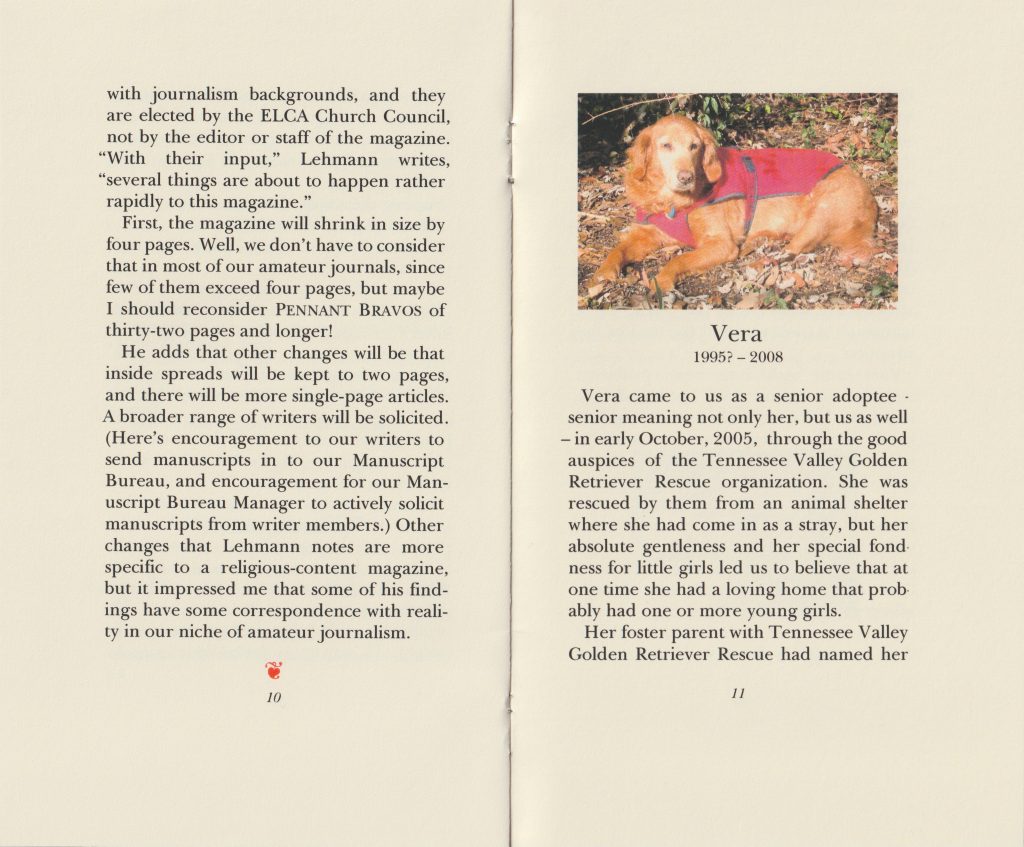
Vera
1995? – 2008
Vera came to us as a senior adoptee – senior meaning not only her, but us as well – in early October, 2005, through the good auspices of the Tennessee Valley Golden Retriever Rescue organization. She was rescued by them from an animal shelter where she had come in as a stray, but her absolute gentleness and her special fondness for little girls led us to believe that at one time she had a loving home that probably had one or more young girls.
Her foster parent with Tennessee Valley Golden Retriever Rescue had named her Faith Ann, but when we adopted her we happened to be hosting Elena Maryasova and Vladimir Sidorov, two of a group of ten young Russian environmentalists who were studying environmental affairs for eleven days in East Tennessee through the Open World program of Friendship Force International. We asked them what the Russian word for “faith” was, and on learning that it was “vera,” we decided immediately to rename Faith to Vera, as a memento of their visit and the time of the adoption.
Vera came with some heart problems and she was almost deaf, but she dearly loved our half-mile walks in the neighborhood. Meeting people on the walks is when we noticed her special fondness for girls. But she was affectionate and gentle with everyone – us, our cats, guests in our home, and visitors and dogs we met on our walks and on our travels. She loved to ride in the car and RV, and traveled with us to Ohio and Illinois several times, though asleep most of the time!
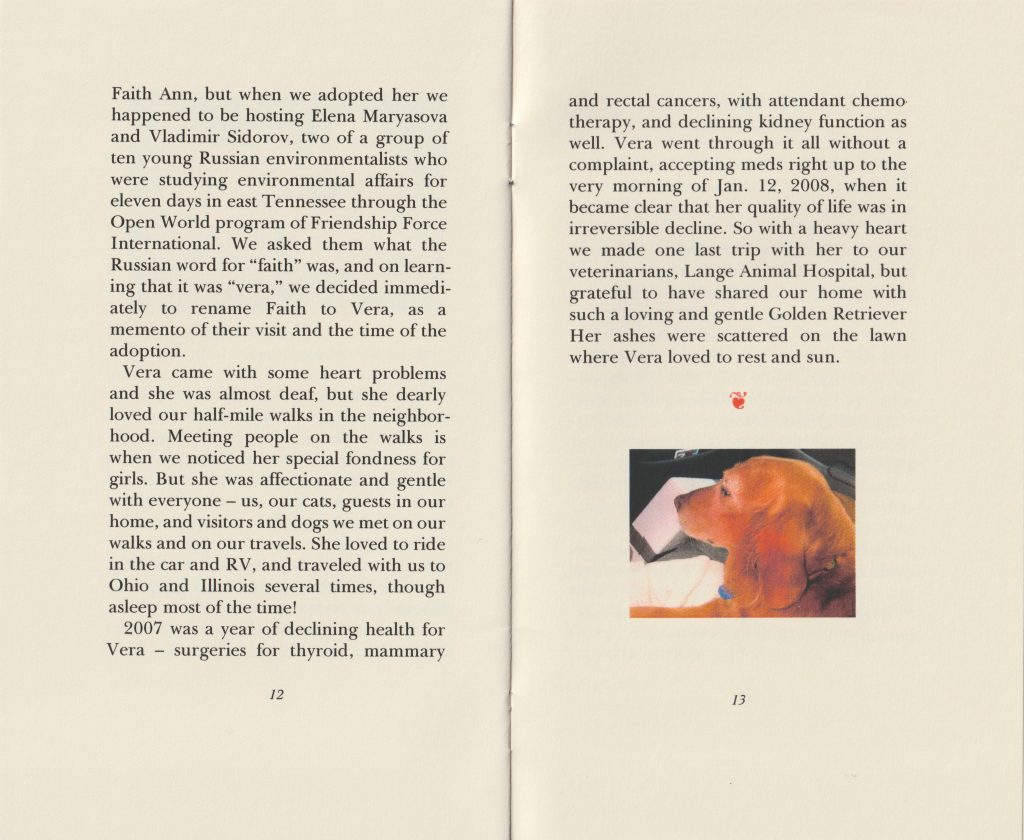
2007 was a year of declining health for Vera – surgeries for thyroid, mammary and rectal cancers, with attendant chemo therapy, and declining kidney function as well. Vera went through it all without a complaint, accepting meds right up to the very morning of Jan. 12, 2008, when it became clear that her quality of life was in irreversible decline. So with a heavy heart we made one last trip with her to our veterinarians, Lange Animal Hospital, but grateful to have shared our home with such a loving and gentle Golden Retriever. Her ashes were scattered on the lawn where Vera loved to rest and sun.
Africa Is Our Nation
by Daniel V. Rowe
I am African. My original ethnic comes from an African woman, she was named “Eve.” She is a queen, our “Mother Africa.”
Being stolen from our lovely country of birth has separated us from our people, and keeping us uneducated and unaware of our history was a way of keeping us down. African on African crime and hatred did not just come to self mind and initiated drama – the U.S., who kidnapped us, stirred up problems among us African kings and queens to stop us from standing together and being strong and powerful as a nation.
Daniel Verdell Rowe. Don’t sound African, do it? That’s because it’s not. It’s what they call a slave name. I don’t think it actually means anything. But an African name always has meaning. I can say that my oldest sister did give my oldest niece the right name, “Jamila,” which means beautiful in Swahili. She’s blessed.
I have been sitting behind bars since 1994 hearing brothers use the “N” word over and over, again and again. The word saddens me to hear another black person use such words, especially to each other. I stopped using the “N” word long time ago years ago. There’s men old enough to be my father or even grandfather that use the “N” word like fluent language. I’m the schooler and encourager, but they should be my mentors.
It wasn’t nice having our country taken from under us and being turned out. It’s not funny, nor nice to be left starving without food, clothing, shelter, medical care and etc. Some of us are over here with all the stupidity, complaining and fighting each other when we have opportunities unlike other countries.
I pray for all of my African people over in Africa that our country Africa will be put into place as a worthy rich country. Not just money, but health care, housing, food and other needs.
Red, we’re blood. Black, our people. Green, African land and our future.
Umoja! African pride.
Daniel V. Rowe is an inmate at Folsom State Prison, Represa, California. He learned of NAPA in some way, and sent me this piece of writing, which I have only slightly edited.
I offered to send him a paperback copy of Alexander McCall Smith’s best-selling The No. 1 Ladies Detective Agency, since that series of novels reflects a modern African dignity, told through the character of Mma Ramotswe, proprietor of Botswana’s first and only female detective agency. Daniel was interested in reading it. I have not yet heard if he received it, and if he did, whether he enjoyed it as much as Ruth and I did.
Published by Bill Boys
Knoxville, Tennessee 37919-8224
Member
National Amateur Press Association
Established in 1876
www.amateurpress.org
Composed with Serif PagePlus Ver. X2: TrueType 10.5-point Baskerville.
Printed on a KonicaMinolta QMS 2300W color laser printer, on Domtar Natural Smooth 80-lb. Text.