 editoradmin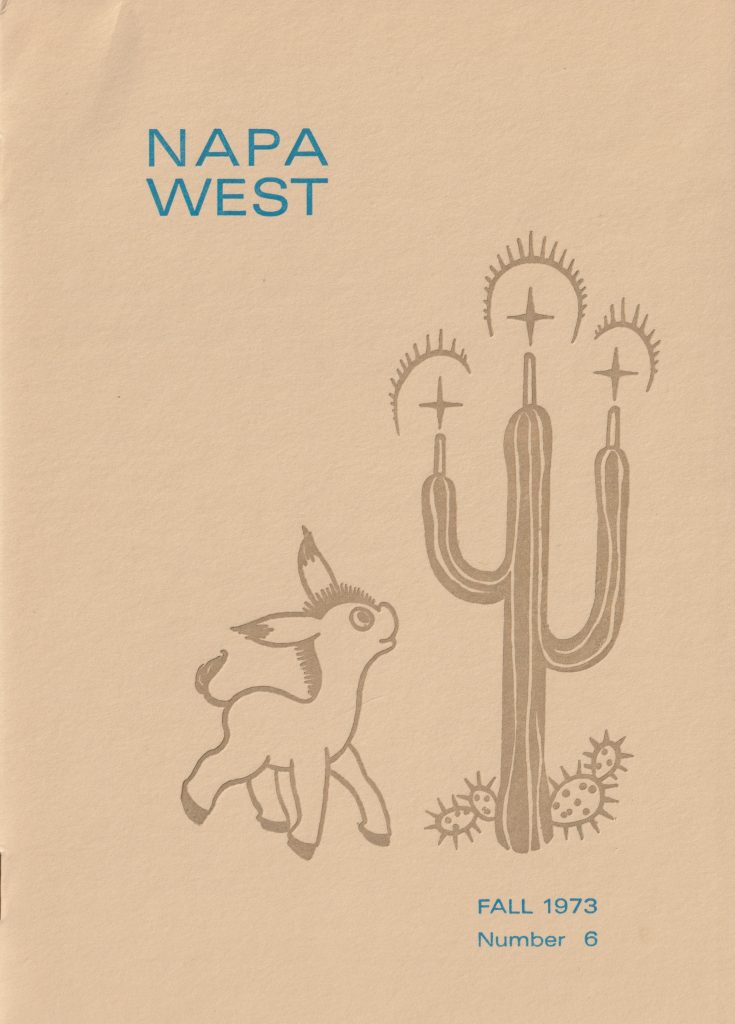
The Way West
Cast of Characters
NAPA WEST Chief Mogul & Producer – Gale Sheldon
Directory & Surfside Press Host – Ed Fielding
Vice President in-charge-of-practically-everything – Glenn Engebretsen
Chief Writer (of stories too long for publication) – Dave Oden
Ex-Chief (sets type on a 10-speed bike) – Dick Baughman
Editorial Writer, & Local Ajay Elder Statesman – Harold Ellis
Two-Color Printing Artist & Heir Apparent to NAPA WEST Wigwam – Thor Willat
Absentee Indians who Slings Arrows from Afar – Pauline Walters & Ann Vrooman
New Members Initiated into the NAPA WEST Printing Holocaust – Dana & Rusty Pinizzotto
Refugee from the Arizona Reservation – Don Lowry
Board of Directors – Lucy Fielding & Sally Engebretsen
How They Do It in Hollywood
The infamous casting couch was sagging as NAPA WEST drafted the scenario for the ‘74 Convention. Gale Sheldon’s riding crop and trumpet fanned the air as he directed the story conference. Harold Ellis, past director of the Busby Berkeley follies, put the girls through their paces – and set fire to the couch. Dick Baughman volunteered to do a high wire bicycle ride across Mission Bay singing “California Here We Come.” Glenn Engebretsen will be fired from a cannon and attempt setting the first line of type while in free fall. Thor Willat will do a sword swallowing act while setting the Bill of Rights in Cheltenham Bold. Don Lowry will carve a linoleum block of a four mile stretch of Broadway. Dana and Rusty Pinizzoto will juggle a Volkswagen and printing press while Ed Fielding pelts them with worn out type. Other exciting parts are available in “The Way West” Report here July 4th for your costuming and make-up. You haven’t heard anything yet. At the end of the conference Lucy Fielding and Sally Engebretsen brought sea water and doused the couch, sending all to the printshop.
Festive Frolic at Fielding’s – October 21
South and west you cannot much farther get and still be in the continental United States, than we are at the Fielding’s fabulous Surfside Press tucked between the Pacific shore and the Bay of San Diego. Convention ‘74 was the big topic of the day, and plans were made to insure that it will be a fine one. Gale Sheldon has thought of everything and more to make it so. What we need now is for you to be with us on July 4-5-6 in superb San Diego. Our VIP call of the day was to Executive Judge Ann Vrooman, too many miles up the coast, to tell her that we miss her merry presence, and that we appreciate her continued efforts on behalf of NAPA and NAPA WEST. It was reassuring to feel her warm, friendly personality again, even if only over the wires. – Glenn Engebretsen
Happiness is many things to many people: the Fieldings are wonderful hosts, making even the newest members feel at home. I welcome the friendly advice. Maybe Rusty will understand what fun it is and help clank our Kelsey (and pi type). So far, printing makes as much sense to him as thermodynamics makes to me. But if he helps me with the printing, I’ll be willing to try thermodynamics! – Dana Pinizzotto
Nouveau Californianus
by Dave Tribby
Some NAPA members may be surprised to find me – Dave Tribby of the SAPS – appearing in NAPA West. It’s not so very strange… after all, I’ve lived on the west coast for over 20 years. It’s just that I’m temporarily transplanted to the Pacific Coast from Florida’s west coast. The reason – Stanford University near San Francisco.
Those who attended the St. Pete convention may recall that I was finishing up at St. Petersburg Junior College and was uncertain where I would be going after graduation. During the last week in July Stanford sent word that I had been accepted as a transfer student. This came as somewhat of a surprise, and I had to change quite a few plans. (A week later I would have registered at the University of West Florida in Jack Bond’s home town of Pensacola.)
A major problem was the shortage of housing on campus. This was solved by a friend who had a relative living near Stanford and had rented a room in the past. A call to Palo Alto reserved the room for me – but this meant I would need my car to get back and forth to school.
So bright and early on Saturday, September 15, Dad and I piled into my Maverick and started for California. Four and a half days (and 2800 miles) later we pulled up at his uncle’s apartment in Oakland.
For the next week Uncle Chet and Aunt Merle were terrific hosts, showing us the sights in the Bay Area (Cable cars, Fisherman’s Wharf, Chinatown). And I was able to get things ready at Stanford. Dad flew back to Florida on the 26th, the same day classes began.
The period since then has been filled with adjustments – such as not having any printing equipment. It would have been nice to have been at the Oct. 21st meeting of NAPA WEST, but San Diego is over 500 miles from Palo Alto. Maybe I will be able to join in their typesetting fun some day, but for now I’ll rely on Glenn Engebretsen to set my words for NAPA West.
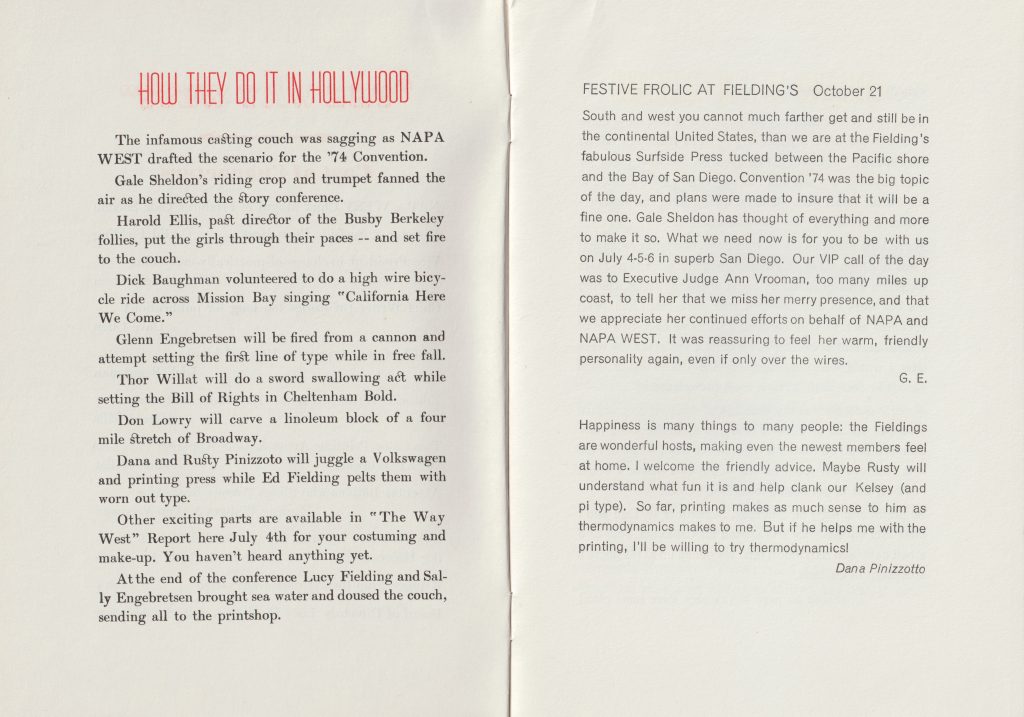
Ann Vrooman’s Vignette: Glenn Engebretsen
I’d always wanted to take a picture of Glenn Engebretsen sitting at his little round white table, his feet dangling into the gentle surf at Playa del Rey, while he wrote his memoirs. Now I’m too far away to approach him from this angle. But there really is no “one-angle” approach into all the nuances of Glenn’s many-faceted personality and character.
To some people he appears conservative. Many consider him quietly wise. Well, I’ll grant he’s wise but I’ll back off from saying he’s quiet or conservative. He’s as noisy as the devil in a good argument which he probably prompted. How well I know; and I know, too, that he sometimes wins even after I’ve thrown my best punch. His politics are conservative, but there is much about Glenn Engebretsen that I refuse to call conservative. He’s truly an individual, stands up for what he believes, has tremendous perceptivity and intuition, and his keen mind is very quick. He’s as impatient as the devil on occasion but only because he’s anxious to get the job done.
He and his lovely wife, Sally, are both nature lovers. Along with their home overlooking the Pacific, close to his shop, they own a small ranch in Yucaipa, California, where they commune with things of the spirit. Out there it is quiet and beautiful, and they are surrounded by pomegranates, apricots, oranges, grapefruit, lemons and berries.
I first felt I came to know Glenn the time he emerged from the bowels of his own blackberry pit, covered with berry juice, grinning from ear to ear, glad to share the wealth, and still wearing his funny old yachting cap that is as much a part of him as “Honest Abe’s” stovepipe.
Glenn has his own wine-tasting room. He’s moved his little round white table down to a ledge over a pretty gulch where you can sit in the sun-patterned shade and hear bamboos swaying in the breeze. If you don’t drink orange or blackberry wine, or have a slice of homemade bread or pie with coffee, you can always watch birds. Glenn’s a real bird-watcher, as is Sally.
Glenn gets up in the wee hours before dawn, walks up and down the length of his acreage, and on occasion becomes a skunk-watcher. Not alone at this (unenviable-to-me) sport, he joins a neighbor or two perching over an old shed. What scares me is that one night that roof will give way completely and he and his neighbors will have a totally different view of skunks with too much hind-sight.
I call him a tarantula-teaser. One day I brought my grandchildren to the Engebretsen ranch for bags of apricots. They wanted very much to see their first real live tarantula. I’d never seen one either. So Glenn, wanting to please, almost drowned a poor tarantula in his hole. The poor thing came up for air and we were thrilled to see the beautiful velvet coat the little creature wore.
Glenn is also a chocolate lover. You can sometimes “almost” win him over with good chocolate flavor. He carries around little plastic bags of the sweet, Belgian imported. Sometimes Dutch. He admitted he liked the Scotch chocolates I once gave him. He’s “worldly” sweet. And he’s lucky because I don’t think he’ll ever get plump from chocolate.
Well, Glenn has his fun side and his serious side. He also has a very human and very humble side. He was thrilled to have won the editing laureate last year. It was hard for him to believe. Well, believe me, he’ll be walking away with the miscellaneous prose laureate when he finds the time to write some of the things he wants to. Meanwhile, he is happy for all the other winners. His generosity in many areas of “giving” is tremendous.
Glenn Engebretsen is a self-made man. With a degree from USC he chose long ago to be a printer. He enjoys his work, his life, his family. And he enjoys NAPA. We’re lucky to have him as member and more especially as our vice-president. And I, for one, look forward eagerly for many, many more issues of his beautiful paper, Galley West.
Quotes from Glenn’s Galley West
On Being His Own Man – “I demand my right to think for myself and to say exactly what I think, realizing, of course, that no one has to listen, but if anyone chooses to, he should be allowed to.”
A Typographic Prediction – “Change for the better comes slowly (change for the worser is quicker) but someday you’ll wonder where the serifs went when readers of the future receive all their published information via crisp, cool lines of type without antiquated impedimenta.”
Here We Go Again!
by Thor Willat, illustration by Elly Willat
Mexico City, Sept. of 1969, I was first introduced to the so-called “Photo Truck,” a diabolical form of outmoded transportation that was to play an unforgettable part in my life the next few months. At every airport, there it was; that four-wheeled monster, waiting for us impatiently, snorting and biting at the dust, raring to be off and running. Often it was well primed for the occasion the day before with a fresh coat of paint, just sticky enough to leave its mark on our clothes for the rest of the day.
The assignment that brought me to this strange plight was film coverage of the Apollo 11 astronauts on a world goodwill tour, with Mexico City the first stop.
Shortly after the airport ceremonies, we were loaded into this monstrous contraption. Soon it was listing to one side or the other, bulging with numerous members of the press, all trying frantically to arrange arms, legs, and equipment into some sort of workable position. I had an uneasy sensation in the pit of my stomach as I struggled along with the others in this unbelievable situation. No sooner had I made it, when a giant thrust, a billow of smoke and a grinding of gears, we were off and flying.
Let me give you an idea of the special qualifications needed for photo trucks; no springs or shock absorbers, the hardest of tires, very rickety side rails held together with some old wire – and a lot of prayer. The drivers are a special breed of wild man, equipped with glassy eyes, oblivious to curbs, chuck holes, and pedestrians. Also, with enough knowledge of physics to take every turn at breakneck speed, just short of capsizing. It’s an accomplishment they are particularly proud of. Some probably have a “Black (and blue) Belt” in “Photo Truck.” And I am sure they have a preparatory ritual with the local brew, before getting behind the wheel.
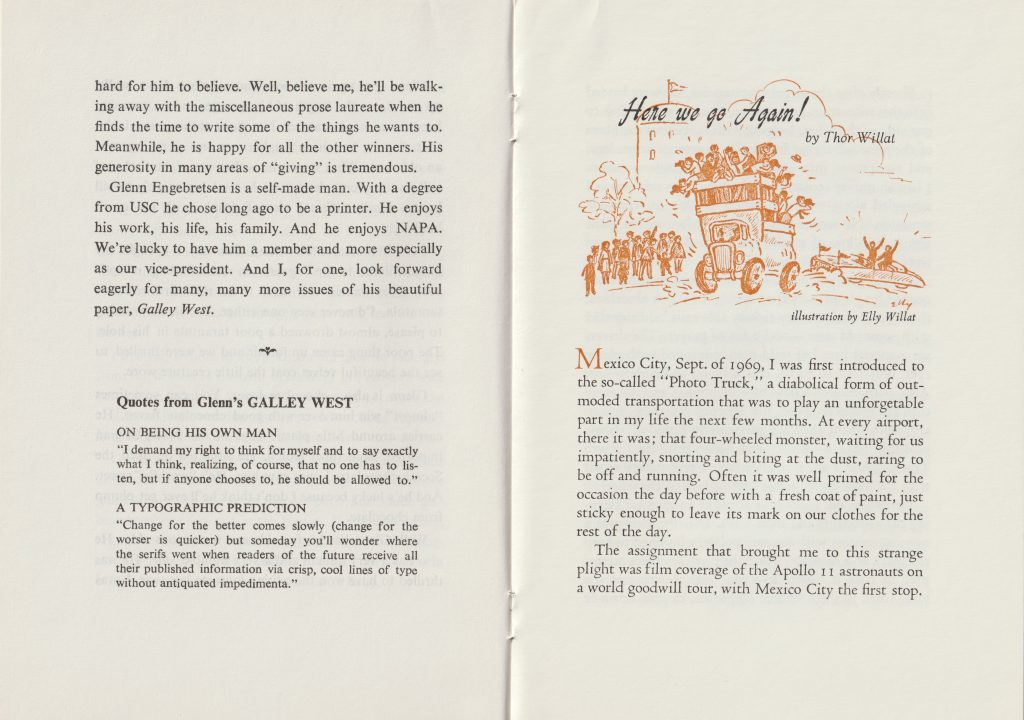
Generally, our truck rode ahead of an open car carrying the astronauts and local VIPs. Usually there was a running contest with security police, who tried to keep the truck at a distance, while the photographers attempted to coax it closer. Everyone was shouting at the same time, in three or four languages, to slow down or speed up. Some banged on the truck cab or stomped their feet to get the driver’s attention, while throwing a few invectives that were unmistakable in anyone’s language. The operation took on all the color of a Keystone comedy.
Near the end of our tour through Mexico City, I decided to get off for a citizen’s-eye view of the astronauts, now wearing gigantic sombreros, as they shook hands and kissed babies. I squeezed myself through the wildly enthusiastic crowd to get a few good shots, then looked back for the truck, which was by now more than a block away, with a solid wall of people in between. Miserable as our truck was, at this point, it was still better than no truck. Luckily, I was able to hitch a ride on the back of a pick-up and made it to the hotel in time to rejoin my group.
In Buenos Aires, as we were completing our parade through the city, the photo truck suddenly drove over the center divider, raced across a lawn and up a side street, scattering pedestrians like chickens. I could see the look of concern on the faces of the astronauts and their wives as our truck sped crazily away from the convoy. All kinds of wild thoughts must have been going through their minds, as they were ours, like being kidnapped or hijacked. But a few minutes later, well away from the city center, our driver jammed the brakes, sending us sprawling, and wondering – what now…? Then he jumped out alongside the highway, and in full view of all, tended to an urgent need to eliminate some previously consumed cerveza. There were numerous reactions; some amazement, some grumbling, and some chuckles… and a few of us who would have liked to join him, but lacked the nerve. With perfect timing, we were back on the highway and rejoined with our caravan… much to everyone’s relief.
Our conveyance in Berlin was an extremely towering monster of about six levels, and no ladder or steps. We had to climb the sides Tarzan-style. I was pushed to the top level by eager, heavier photographers scrambling for lower positions. But later, this gave me a good vantage point at the Berlin Wall. Until then, it was definitely hairy. Our driver knew how to “burn rubber” like American parking attendants; how to lean all six levels just up to the point of no return; and which overpasses he could clear by inches. At each approaching bridge, a loud chorus of “achtung” warned the top layer to duck. (and we did!)
However, it was a much different story in Teheran. Our entourage was so impressive, an emotional woman chanting devotions to Allah, threw herself on the hood of our truck. It took three husky policemen to pull her off and convince her we were not descended gods.
Thinking back on it all… the generous protection of the gods had to be with us. How else could we have gone through twenty-three countries on twenty-three of those incredible contraptions… and survive to tell about it!
A Visit to our Idaho Amateur:
Where the Road Narrows
by Gale Sheldon
I wheeled the old truck west out of Boise on Interstate 80 and nearly got lost finding State Highway 19 out of Caldwell. August farm crops were nearing harvest on both sides of the road as I headed into the sun. The corn stood as tall as the top of the high cab on the ‘55 Chev. pickup.
The smell of harvest was everywhere except a spot on the rail spur named Simplot. It was evidently a fertilizer plant built by a local man who made good developing dehydrated spuds for the troops in World War II.
Every few miles the road narrowed and I slowed my pace. I braked abruptly as a woman slowed to make a right turn off the narrow highway. Was that a dirty look she gave me as she glanced back at my old truck which towered over her rear bumper? I could almost hear her mutter, “Dumb California driver!”
At the end of Highway 19 I followed Frank Mercer’s directions and stopped in the driveway of an impressive ranch style house which overlooked the Snake River valley. It was built to take in the commanding view on three acres at the bluff of the river. Not far from here my own Dad had herded sheep and gone swimming more than half a century before.
In an easy-going manner Frank impressed me when he noted that he had built the house himself and toured me through the full basement to his printshop with the 6 by 10 Kelsey. Well-stocked with type, paper, and supplies, the orderly shop showed the efforts of an active printer.
But it was his “new” press that showed his dedication to printing. He took me to his garage behind the house where he was winterizing the building to house an aging 12 by 18 Chandler and Price which he had actually rescued from a junk yard. But that is a story for him to tell.
In a quiet way over coffee made by his wife, Lois, Frank and I discussed the special problems of a lone amateur learning the art of printing from books and tips from others. And how important the suggestions and help from other amateurs can be! Twenty-five years before, I had been the only ajay in Idaho.
All too soon I had to leave and the narrow road widened as I found my way back to the Interstate. “Better come to the National’s convention in San Diego next summer,” I had suggested. I think he liked the idea. And maybe he will, at that.
An Open Letter to Barrel Regal and Alfalfa Hick, Perpetrators of that Extinguishable Publication, “Shambles-Pain”
The world-famous NAPA, er, San Diego Zoo has always maintained a strict open door policy. All inhabitants are kept uncaged and mingle freely with visiting dignitaries, whether native born, naturalized, or pied (pie-eyed?). This policy appears ready-made for such creatures as pound typewriters or bang presses and are sometimes referred to as “a-jays,” a rather mottled species of rare birds.
Recent noise from the wilderness to the East indicates that blood brothers Beagle and Schmick should feel right at home in this friendly atmosphere of birds and beasties. We have reserved special padded cages for this pair who will no doubt be a special attraction at next summer’s wild animal show here in San Diego.
Yours for more color and less smell at the Zoo,
High Wind Seldom
P.S. The local zoo-keeper informs us that because of current inflation all non-resident traveling zoo-ajay-ists should bring their own bananas.
Come to San Diego in 1974!
by Harold Ellis
About once in 20 years, on the average, a NAPA convention comes to California, so we especially urge you to attend the one to be held in San Diego in July of 1974.
The first convention in California was held in San Francisco in 1886. It was followed by others, also in San Francisco, in 1897 and 1904. In those early years San Francisco was the big metropolis of the state. It is now surpassed by both San Diego and Los Angeles, these areas benefiting most from the mass migration to the southwest.
Due to the 1906 San Francisco earthquake and fire many amateurs lost their printing equipment and files of papers, and activity came to a standstill. Thirty years later a new crop of amateurs in the area brought the 1935 convention to Oakland. This was a notable convention and many present-day amateurs attended.
Although amateur activity in Southern California had extended over many years it was spasmodic and confined to a few individuals. In 1944 a new Southern California Amateur Press Club was formed. Monthly meetings were held and membership increased rapidly to about 20 in the Los Angeles area. Many papers were published, including Southern Californian, Cameo, Welcome News, Saludo.
This interest and activity brought the convention to Los Angeles in 1948. Now, a quarter of a century later, new members have come on the scene to re-vitalize the area.
Everyone is welcome to come to San Diego for a fun time of meeting old and new friends in the amateur world, but we especially urge those in the West to attend. You don’t want to wait until 1999 do you?
99th NAPA Convention – San Diego – July 4, 5, 6
Page Eighteen
by Glenn Engebretsen
NW Editor Sheldon was most careful in not assigning me to Page Five, having noted my many struggles with it in the days before Galley West became more or less otiose. As a matter of fact, I’m still struggling with P5 in GW #8, whose dateline reads October, 1973 though the first 4 pages were printed in July, and the October bundle seemed an easy target. But when you miss one deadline the rest come easy. Easy, that is, until you work under an editor like Gale who keeps you jumping and who will tolerate no missed deadlines, nor any other nonsense (at least not much.)
So now Page Eighteen is my adversary. I discovered early in trying to be an ajay editor that one way out of the dilemma is to put the problem page’s name in the headline and babble along until an idea (or what passes for one) pops up, and sure enough, one just has. How about a Procrastinators’ Journal? Do we have enough procrastinators whose publishing consciences are not yet extinguished who will put out a page or two, then forward them on to the next rehabilitation candidate until the anchor man is reached? Should there be other true believers in ajay tho publishing delinquents like me, please do sound off. Admittedly, ideas such as this are far from the well thought out, brilliantly planned cerebrations of a William Earl Boys, but is about all you can expect from a Page Eighteen.
Field Day at Fielding’s
by Thor Willat
NAPA West was fortunate to have Edgar X. and Mrs. Fielding as hosts for their winter meeting. After a delicious lunch, we were like kids in a candy store going through Ed’s Bewick wood engravings; one of the west’s finest collections; and his beautiful old books, many on Bewick and his work. Then, of course, we had to pump the pedal of his painted like-new 8 x 12 C&P. Time to leave came all too soon.
Little Snowflake
by O. Pauline Walters
Little snowflake, soft and tender,
As I hold you in my hand
You melt away to a drop of water
And float away to a fantasy land.
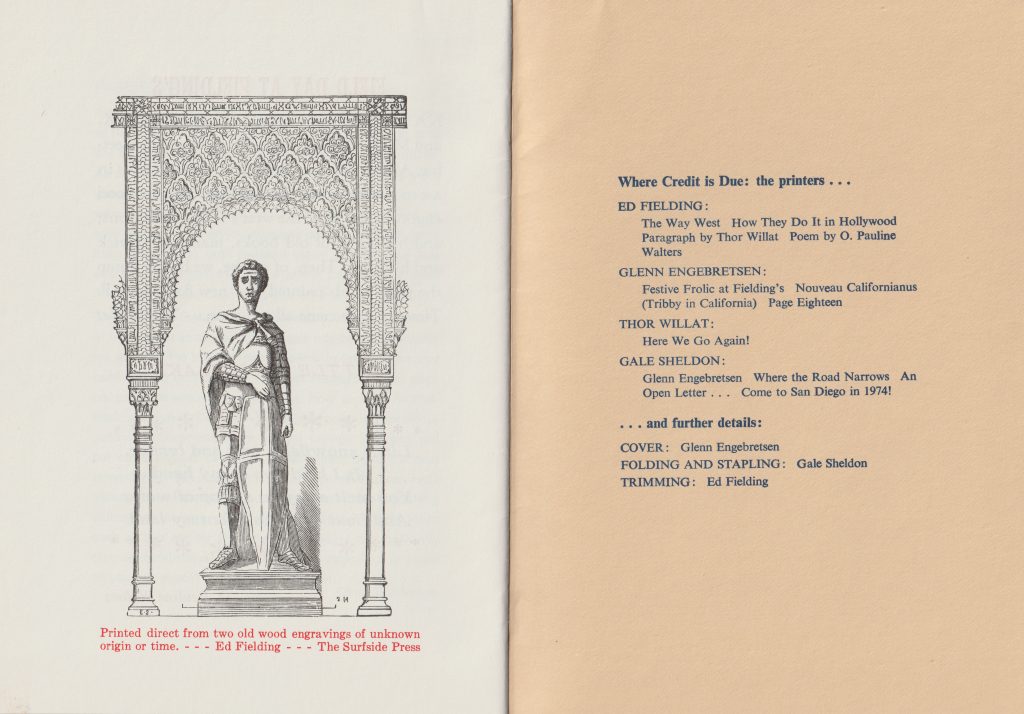
Printed direct from two old wood engravings of unknown origin or time. – Ed Fielding – The Surfside Press
Where Credit is Due: the printers…
Ed Fielding:
The Way West | How They Do It in Hollywood | Paragraph by Thor Willat | Poem by O. Pauline Walters
Glenn Engebretsen:
Festive Frolic at Fielding’s | Nouveau Californianus (Tribby in California) | Page Eighteen
Thor Willat:
Here We Go Again!
Gale Sheldon:
Glenn Engebretsen | Where the Road Narrows | An Open Letter… | Come to San Diego in 1974!
… and further details:
Cover: Glenn Engebretsen
Folding and Stapling: Gale Sheldon
Trimming: Ed Fielding