 editoradmin
Picture 1: The Twin Towers of the World Trade Center, New York, aerial view, March 2001.[2] The North Tower is on the left, and the South Tower is on the right (…Little did we know that the towers were on borrowed time…)
Prologue
We are now observing the twentieth anniversary of the horrific attacks that occurred on September 11th, 2001 – now simply called 9/11. That was long enough ago that some may have forgotten what all occurred that day, and indeed, those in their 20s or 30s may not really know much of anything about what transpired that day when thousands of people were brutally murdered. Here are my own recollections of the events of that terrible day, and in particular, the mood of the city.
Encyclopedia Britannica states, “September 11 attacks, also called 9/11 attacks, series of airline hijackings and suicide attacks committed in 2001 by 19 militants associated with the Islamic extremist group al-Qaeda against targets in the United States, the deadliest terrorist attacks on American soil in U.S. history.”[3]
At the opening of the CBS Evening News on 9/11, Dan Rather said, “You will remember this day as long as you live.”[4]
Because this is a personal recounting of the events, I am focusing on just the New York City events. Further attacks followed at the Pentagon and in Shanksville, Pennsylvania, but I wasn’t there to see those; I did see the events in New York City, so that is what I am reporting here, from my viewpoint as a bystander – just an observer. I fortunately wasn’t inside the World Trade Center towers, so I’ll describe what I observed around midtown Manhattan, and I’ll back up my comments with references.
Even as a bystander, I find that even twenty years later, this is still a very emotional topic for me to talk about or write about.
Background
First, some background: New York City’s two World Trade Center (WTC) towers, popularly called the “Twin Towers,” were built in 1971, and at over 1360 feet in height and 110 stories each, were at the time the tallest buildings in the world. They were about double the height of any of the other buildings around them in lower Manhattan.
On February 26th, 1993, radical Islamic terrorists bombed the North tower of the World Trade Center in New York City by driving a truckload of explosives into the underground parking garage beneath the tower.
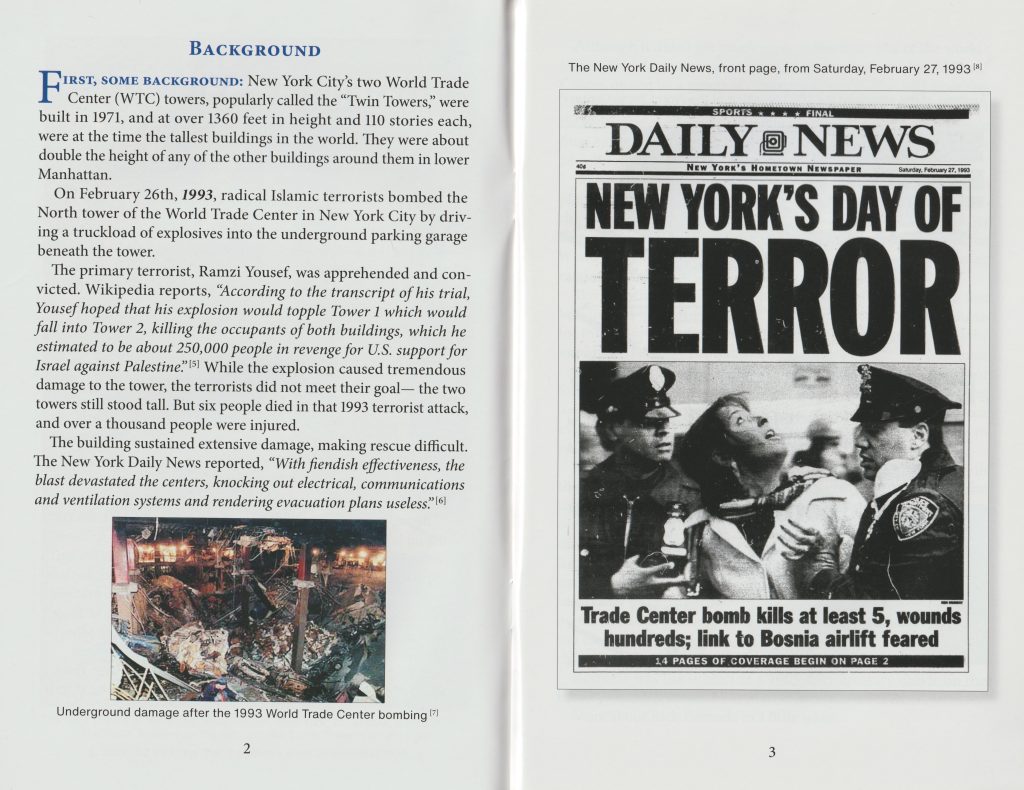
The primary terrorist, Ramzi Yousef, was apprehended and convicted. Wikipedia reports, “According to the transcript of his trial, Yousef hoped that his explosion would topple Tower 1 which would fall into Tower 2, killing the occupants of both buildings, which he estimated to be about 250,000 people in revenge for U.S. support for Israel against Palestine.”[5]While the explosion caused tremendous damage to the tower, the terrorists did not meet their goal – the two towers still stood tall. But six people died in that 1993 terrorist attack, and over a thousand people were injured.
The building sustained extensive damage, making rescue difficult. The New York Daily News reported, “With fiendish effectiveness, the blast devastated the centers, knocking out electrical, communications and ventilation systems and rendering evacuation plans useless.”[6]
Picture 2: Underground damage after the 1993 World Trade Center bombing[7]
Picture 3: The New York Daily News, front page, from Saturday, February 27, 1993[8]
Picture 4: Analysis of the effects of the 1993 bombing of the World Trade Center from the U.S. Fire Administration/Technical Report Series, U.S. Department of Homeland Security[9]
Although it didn’t get much press at the time, one of the world’s largest gold depositories was located underneath the World Trade Center, owned by a group of commercial banks. The 1993 bombing detonated close to the vault. Wikipedia reports, “Seven weeks after the September 11 attacks, $230 million in precious metals was removed from basement vaults of 4 WTC. This included 3,800 100-Troy-ounce 24-carat gold bars and 30,000 1,000-ounce silver bars.”[10, 11]
Following the 1993 bombing, many new procedures were put into place for security checks, within the building and of course within the parking garage, and changes to the building were installed. As an example of one such change, the Port Authority (the owner of the World Trade Center buildings) installed photoluminescent pathway markings in the stairwells. This later proved to be very helpful.
The financial firm of Morgan Stanley occupied many floors in that building, so they also implemented many new security procedures for themselves. The first two rules that they established were vitally important: First, if some unknown emergency occurs, everyone must evacuate the building as quickly as possible. And second, during or following an emergency situation, no one is to return to the building until management has investigated the situation and is assured that everything is safe. Those two rules ended up saving many lives in years to come.
Rick Rescorla was the Director of Security for Morgan Stanley in the World Trade Center. After studying security issues in 1993, he took the management team out to the street in front of the World Trade Center, had them take a good look up at the towering buildings, and gave them his prediction: “The next attack will come by air.” Those were chilling and fateful words.[12]
Rescorla was the subject of a 2005 documentary movie on the History Channel entitled The Man Who Predicted 9/11.[13]
More about Rick Rescorla in a little while.
Tuesday, September 11th, 2001
From 1998 to 2002, I worked in Manhattan at the investment firm of Morgan Stanley (named Morgan Stanley Dean Witter) between 1998 and 2001). I live in Kingston, New York, about 100 miles to the north, so I took an Amtrak train back and forth each day, about an hour and a half each way. Three hours of travel each day may seem like a lot to some, but it was very relaxed and easy travel; not at all like having to drive and sit in traffic. And this route is actually one of the great train rides in the country, traveling alongside the scenic Hudson River all the way down to New York City.
In this journal, I’m going to describe some snippets of events that took place on that fateful day, September 11th, 2001… but as I mentioned earlier, I want to make it clear that this is meant to be simply a bystander’s view. I watched it happen, but I wasn’t in the World Trade Center. I certainly don’t want to take any attention away from the thousands of people who frantically managed to escape from the buildings during the attacks, or from the thousands who died in the attacks, or from the even greater number of people who lost loved ones on that day, or from the heroic first responders. My main focus is on the events that I personally saw and heard, but I have also included many items from the news that I feel are pertinent to this.
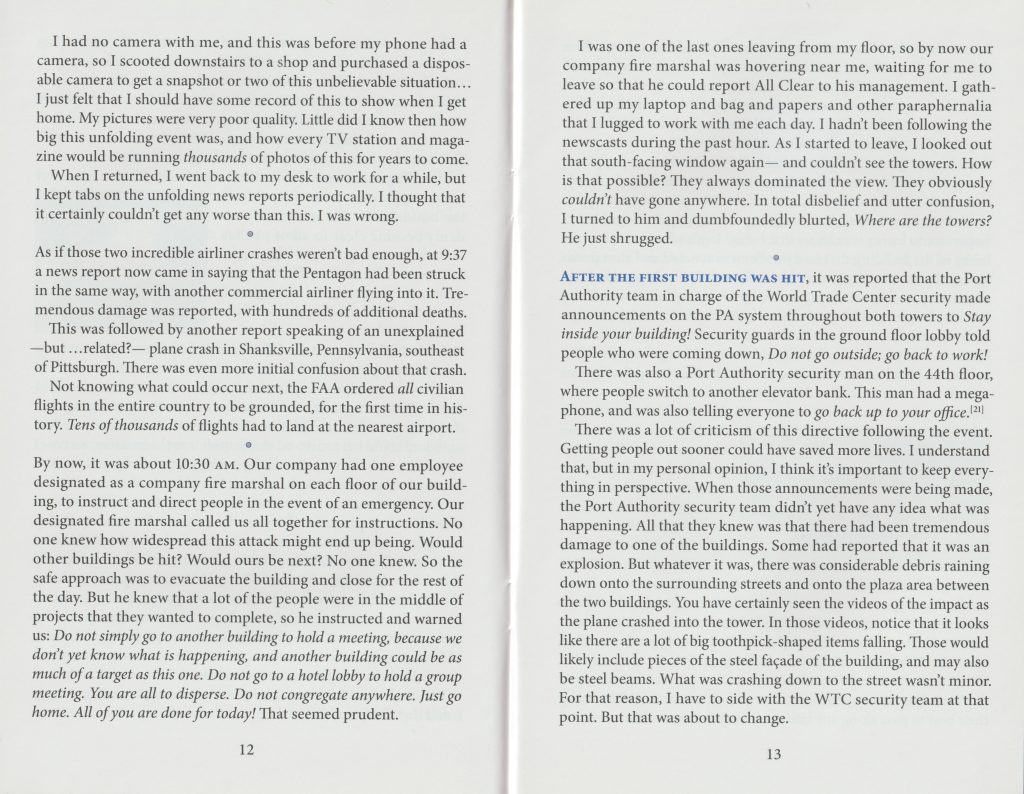
To set the stage for this, I’ll begin with some New York City newscasts: The night before, on Monday evening, September 10th, New York’s WABC-TV Eyewitness News at 11:00 PM started with a view of the World Trade Center buildings, and again during the weather report, predicting that the next day was going to be “sunny and pleasant.”[14]
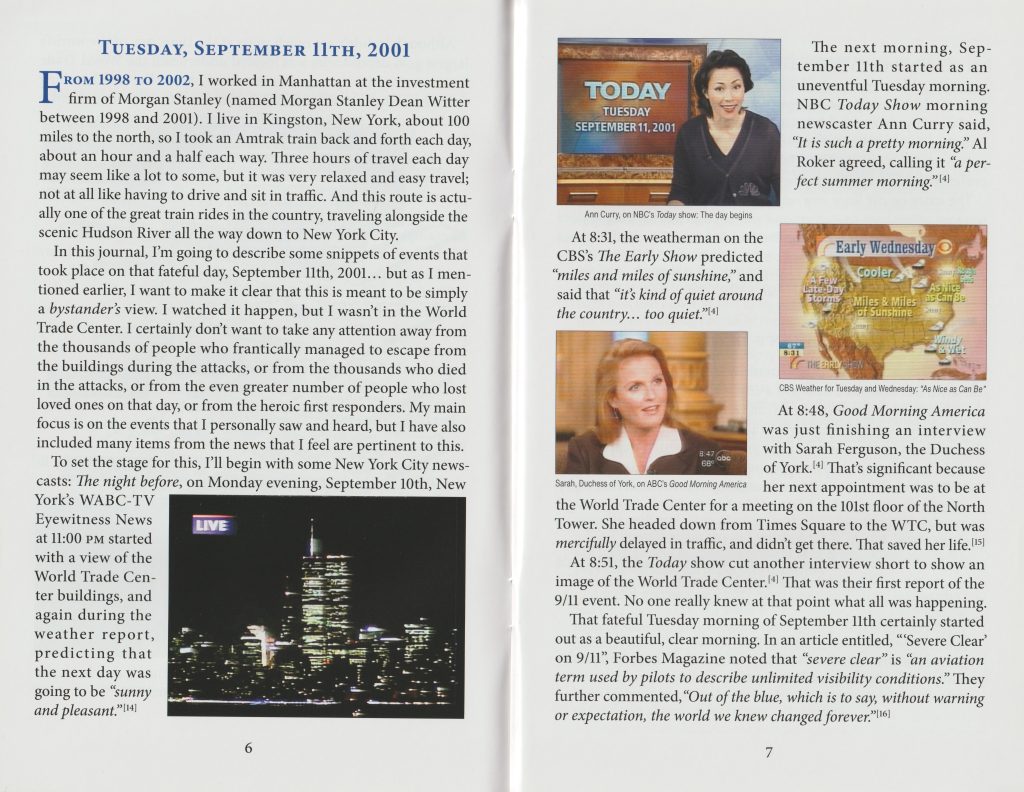
The next morning, September 11th started as an uneventful Tuesday morning. NBC Today Show morning newscaster Ann Curry said, “It is such a pretty morning.” Al Roker agreed, calling it “a perfect summer morning.”[4]
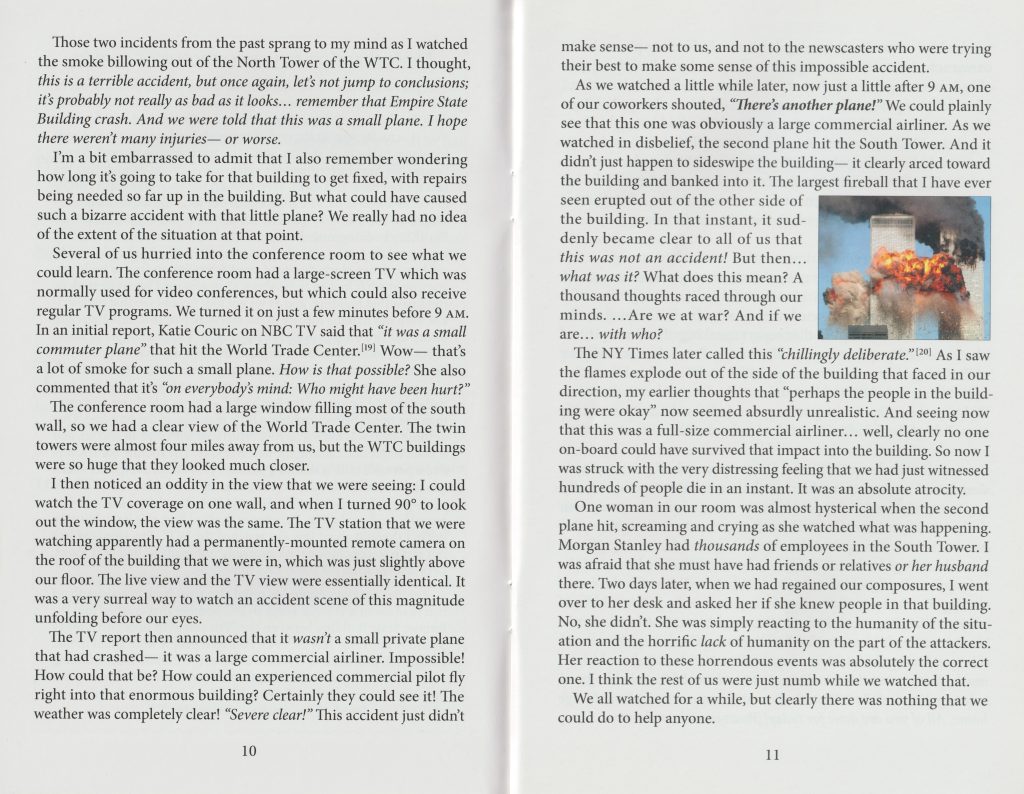
At 8:31, the weatherman on CBS’s The Early Show predicted “miles and miles of sunshine,” and said that “it’s kind of quiet around the country… too quiet.”[4]
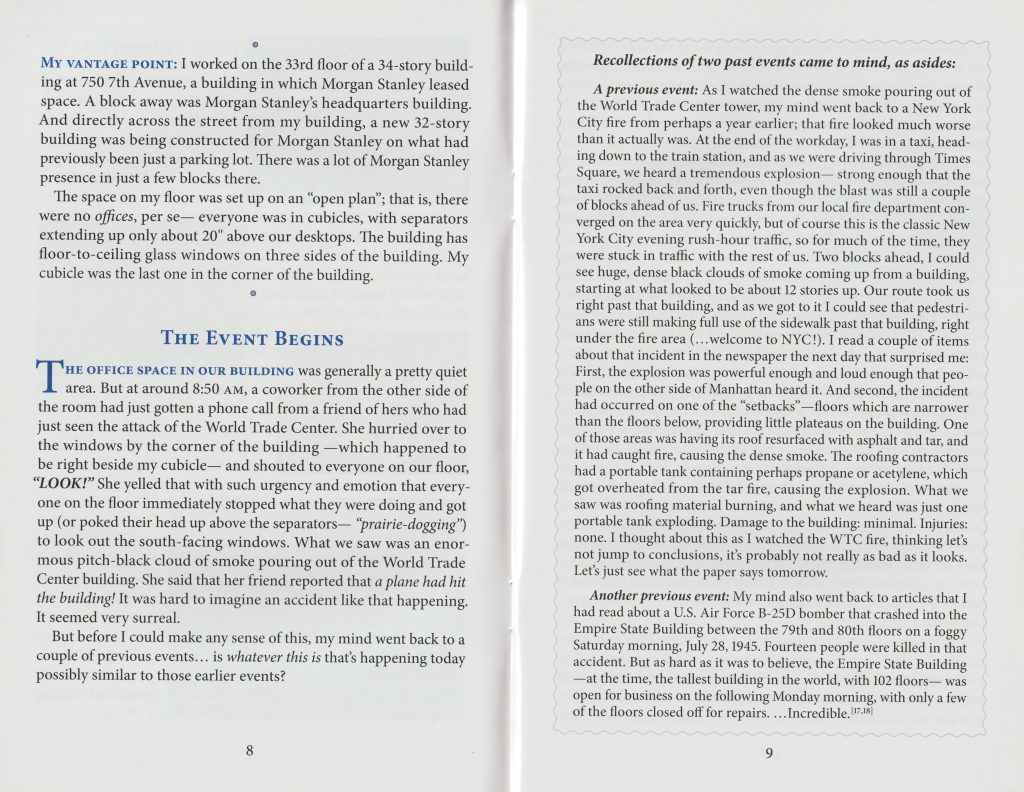
At 8:48, Good Morning America was just finishing an interview with Sarah Ferguson, the Duchess of York. That’s significant because her next appointment was to be at the World Trade Center for a meeting on the 101st floor of the North Tower. She headed down from Times Square to the WTC, but was mercifully delayed in traffic, and didn’t get there. That saved her life.[15]
At 8:51, the Today show cut another interview short to show an image of the World Trade Center. That was their first report of the 9/11 event. No one really knew at that point what all was happening.
That fateful Tuesday morning of September 11th certainly started out as a beautiful, clear morning. In an article entitled, “’Severe Clear’ on 9/11”, Forbes Magazine noted that “severe clear” is “an aviation term used by pilots to describe unlimited visibility conditions.” They further commented, “Out of the blue, which is to say, without warning or expectation, the world we knew changed forever.”[16]
My vantage point: I worked on the 33rd floor of a 34-story building at 750 7th Avenue, a building in which Morgan Stanley leased space. A block away was Morgan Stanley’s headquarters building. And directly across the street from my building, a new 32-story building was being constructed for Morgan Stanley on what had previously been just a parking lot. There was a lot of Morgan Stanley presence in just a few blocks there.
The space on my floor was set up on an “open plan”; that is, there were no offices, per se – everyone was in cubicles, with separators extending up only about 20” above our desktops. The building has floor-to-ceiling glass windows on three sides of the building. My cubicle was the last one in the corner of the building.
The Event Begins
The office space in our building was generally a pretty quiet area. But at around 8:50 AM, a coworker from the other side of the room had just gotten a phone call from a friend of hers who had just seen the attack of the World Trade Center. She hurried over to the windows by the corner of the building – which happened to be right beside my cubicle – and shouted to everyone on our floor. “LOOK!” She yelled that with such urgency and emotion that everyone on the floor immediately stopped what they were doing and got up (or poked their head up above the separators – “prairie-dogging”) to look out the south-facing windows. What we saw was an enormous pitch-black cloud of smoke pouring out of the World Trade Center building. She said that her friend reported that a plane had hit the building! It was hard to imagine an accident like that happening. It seemed very surreal.
But before I could make any sense of this, my mind went back to a couple of previous events… is whatever this is that’s happening today possibly similar to those earlier events?
Recollections of two past events came to mind, as asides:
A previous event: As I watched the dense smoke pouring out of the World Trade Center tower, my mind went back to a New York City fire from perhaps a year earlier; that fire looked much worse than it actually was. At the end of the workday, I was in a taxi, heading down to the train station, and as we were driving through Times Square, we heard a tremendous explosion – strong enough that the taxi rocked back and forth, even though the blast was still a couple of blocks ahead of us.
Fire trucks from our local fire department converged on the area very quickly, but of course this is the classic New York City evening rush-hour traffic, so for much of the time, they were stuck in traffic with the rest of us. Two blocks ahead, I could see huge, dense black clouds of smoke coming up from a building, starting at what looked to be about 12 stories up. Our route took us right past that building, and as we got to it I could see that pedestrians were still making full use of the sidewalk past that building, right under the fire area (…welcome to NYC!).
I read a couple of items about that incident in the newspaper the next day that surprised me: First, the explosion was powerful enough and loud enough that people on the other side of Manhattan heard it. And second, the incident had occurred on one of the “setbacks” – floors which are narrower than the floors below, providing little plateaus on the building.
One of those areas was having its roof resurfaced with asphalt and tar, and it had caught fire, causing the dense smoke. The roofing contractors had a portable tank containing perhaps propane or acetylene, which got overheated from the tar fire, causing the explosion. What we saw was roofing material burning, and what we heard was just one portable tank exploding. Damage to the building: minimal. Injuries: none. I thought about this as I watched the WTC fire, thinking let’s not jump to conclusions, it’s probably not really as bad as it looks. Let’s just see what the paper says tomorrow.
Another previous event: My mind also went back to the articles that I had read about a U.S. Air Force B-25D bomber that crashed into the Empire State Building between the 79th and 80th floors on a foggy Saturday morning, July 28, 1945. Fourteen people were killed in that accident. But as hard as it was to believe, the Empire State Building – at the time, the tallest building in the world, with 102 floors – was open for business on the following Monday morning, with only a few of the floors closed off for repairs… Incredible.[17, 18]
Those two incidents from the past sprang to my mind as I watched the smoke billowing out of the North tower of the WTC. I thought, this is a terrible accident, but once again, let’s not jump to conclusions; it’s probably not really as bad as it looks… remember that Empire State Building crash. And we were told that this was a small plane. I hope there weren’t many injuries – or worse.
I’m a bit embarrassed to admit that I also remember wondering how long it’s going to take for that building to get fixed, with repairs being needed so far up in the building. But what could have caused such a bizarre accident with that little plane? We really had no idea of the extent of the situation at that point.
Several of us hurried into the conference room to see what we could learn. The conference room had a large-screen TV which was normally used for video conferences, but which could also receive regular TV programs. We turned it on just a few minutes before 9 AM. In an initial report, Katie Couric on NBC TV said that “it was a small commuter plane” that hit the World Trade Center.[19] Wow – that’s a lot of smoke for such a small plane. How is that possible? She also commented that it’s “on everybody’s mind: Who might have been hurt?”
The conference room had a large window filling most of the south wall, so we had a clear view of the World Trade Center. The twin towers were almost four miles away from us, but the WTC buildings were so huge that they looked much closer.
Then I noticed an oddity in the view that we were seeing: I could watch the TV coverage on one wall, and when I turned 90 degrees to look out the window, the view was the same. The TV station that we were watching apparently had a permanently-mounted remote camera on the roof of the building that we were in, which was just slightly above our floor. The live view and the TV view were essentially identical. It was a very surreal way to watch an accident scene of this magnitude unfolding before our eyes.
The TV report then announced that it wasn’t a small private plane that had crashed – it was a large commercial airliner. Impossible! How could that be? How could an experienced commercial pilot fly right into that enormous building? Certainly they could see it! The weather was completely clear! “Severe clear!” This accident just didn’t make sense – not to us, and not to the newscasters who were trying their best to make some sense of this impossible accident.
As we watched a little while later, now just a little after 9 AM, one of our coworkers shouted, “There’s another plane!” We could plainly see that this one was obviously a large commercial airliner. As we watched in disbelief, the second plane hit the South Tower. And it didn’t just happen to sideswipe the building – it clearly arced toward the building and banked into it. The largest fireball that I have ever seen erupted out of the other side of the building. In that instant, it suddenly became clear to all of us that this was not an accident! But then… what was it? What does this mean? A thousand thoughts raced through our minds. …Are we at war? And if we are… with who?
The New York Times later called this “chillingly deliberate.”[20] As I saw the flames explode out of the side of the building that faced in our direction, my earlier thoughts that “perhaps the people in the building were okay” now seemed absurdly unrealistic. And seeing now that this was a full-size commercial airliner… well, clearly no one on-board could have survived that impact into the building. So now I was struck with the very distressing feeling that we had just witnessed hundreds of people die in an instant. It was an absolute atrocity.
One woman in our room was almost hysterical when the second plane hit, screaming and crying as she watched what was happening. Morgen Stanley had thousands of employees in the South Tower. I was afraid that she must have had friends or relatives or her husband there. Two days later, when we had regained our composures, I went over to her desk and asked her if she knew people in that building. No, she didn’t. She was simply reacting to the humanity of the situation and the horrific lack of humanity on the part of the attackers. Her reaction to these horrendous events was absolutely the correct one. I think the rest of us were just numb while we watched that.
We all watched for a while, but clearly there was nothing that we could do to help anyone.
I had no camera with me, and this was before my phone had a camera, so I scooted downstairs to a shop and purchased a disposable camera to get a snapshot or two of this unbelievable situation… I just felt that I should have some record of this to show when I got home. My pictures were very poor quality. Little did I know then how big this unfolding event was, and how every TV station and magazine would be running thousands of photos of this for years to come.
When I returned, I went back to my desk to work for a while, but I kept tabs on the unfolding news reports periodically. I thought that it certainly couldn’t get any worse than this. I was wrong.
As if those two incredible airliner crashes weren’t bad enough, at 9:37 a news report now came in saying that the Pentagon had been struck in the same way, with another commercial airliner flying into it. Tremendous damage was reported, with hundreds of additional deaths.
This was followed by another report speaking of an unexplained – but …related? – plane crash in Shanksville, Pennsylvania, southeast of Pittsburgh. There was even more initial confusion about that crash.
Not knowing what could occur next, the FAA ordered all civilian flights in the entire country to be grounded, for the first time in history. Tens of thousands of flights had to land at the nearest airport.
By now, it was about 10:30 AM. Our company had one employee designated as a company fire marshal on each floor of our building, to instruct and direct people in the event of an emergency. Our designated fire marshal called us all together for instructions. No one knew how widespread this attack might end up being. Would other buildings be hit? Would ours be next? No one knew. So the safe approach was to evacuate the building and close for the rest of the day. But he knew that a lot of people were in the middle of projects that they wanted to complete, so he instructed and warned us: Do not simply go to another building to hold a meeting, because we don’t yet know what is happening, and another building could be as much of a target as this one. Do not go to a hotel lobby to hold a group meeting. You are all to disperse. Do not congregate anywhere. Just go home. All of you are done for today! That seemed prudent.
I was one of the last ones leaving from my floor, so by now our company fire marshal was hovering near me, waiting for me to leave so that he could report All Clear to his management. I gathered up my laptop and bag and papers and other paraphernalia that I lugged to work with me each day. I hadn’t been following the newscasts during the past hour. As I started to leave, I looked out that south-facing window again – and couldn’t see the towers. How is that possible? They always dominated the view. They obviously couldn’t have gone anywhere. In total disbelief and utter confusion, I turned to him and dumbfoundedly blurted, Where are the towers? He just shrugged.
After the first building was hit, it was reported that the Port Authority team in charge of the World Trade Center security made announcements on the PA system throughout both towers to Stay inside your building! Security guards in the ground floor lobby told people who were coming down, Do not go outside; go back to work!
There was also a Port Authority security man on the 44th floor, where people switch to another elevator bank. This man had a megaphone, and was also telling everyone to go back up to your office.[21]
There was a lot of criticism of this directive following the event. Getting people out sooner could have saved more lives. I understand that, but in my personal opinion, I think it’s important to keep everything in perspective. When those announcements were being made, the Port Authority security team didn’t yet have any idea what was happening. All that they knew was that there had been tremendous damage to one of the buildings. Some had reported that it was an explosion. But whatever it was, there was considerable debris raining down onto the surrounding streets and onto the plaza area between the two buildings.
You have certainly seen the videos of the impact as the plane crashed into the tower. In those videos, notice that it looks like there are a lot of big toothpick-shaped items falling. Those would likely include pieces of the steel facade of the building, and may also be steel beams. What was crashing down to the street wasn’t minor. For that reason, I have to side with the WTC security team at that point. But that was about to change.
After our building was evacuated, I quickly found myself on the street in midtown, with basically no place to go. I had packed up quickly, so I hadn’t yet called home, but I figured that I could do that when I got outside, so as to not hold up the evacuation effort. When I got outside, though, I found that my cell phone didn’t work… because the cell tower was on top of the World Trade Center, and that was now gone. So, my next choice was to simply use the pay phone along the street (…remember them?). But most of the pay phones had a substantial waiting line, with some of them having 20-30 people in line.
I knew that that was going to be a long wait, and it was important to let my wife know that I was okay, so I went back to the lobby of the building that had just been evacuated and shut down, and asked the security guard if I could use the phone on the reception desk to call home. The guard, who I had said hello to each day, was very helpful and let me do that. I called my wife, Bridget, but got only voicemail. I found out later that she was on the golf course at the time, and presumably hadn’t heard anything about the NYC problems. I left her a message to say that I was fine, and that I was a safe distance from the World Trade Center.
As part of our evacuation notice, we had been told that service for all of the buses and trains in Manhattan had been halted, and the bridges were closed to vehicular traffic, so I knew that it wouldn’t help to try to go to the train station (fifteen blocks south) to start home. I figured that I might even have to walk across one of the bridges and then end up taking a taxi home, which would be a one-hundred-mile cab ride and could easily be $400 (in 2001 money). Therefore, my next step was to find an ATM, and – if it’s still operating – use it while I can, before that service is interrupted, too. After waiting in line there for a while, I withdrew $500.
My next step was to go to a nearby shop and purchase a transistor radio with batteries and an earphone, so that I could hear news reports and learn more about what was happening while I walked. When I got that, what station should I tune to? As it turns out, that didn’t matter – all of the radio stations were presenting news that day. Even the stations that were normally all music were now trying their best to pass along any information that they could.
The primary thoroughfare through the middle of Manhattan is Broadway, a wide one-way southbound boulevard. By the time that I got outside, Broadway was closed to anything other than emergency vehicles starting at Times Square, with policeman at each of the cross streets to control it. They had to be able to get all of the emergency personnel down to the World Trade Center as quickly as possible – down to the area that was now being called “Ground Zero.” Hundreds of emergency vehicles were now racing down Broadway at high speed.
I observed the traffic around me in midtown Manhattan. That day was unlike any day I had ever seen there. I never saw so many emergency vehicles – many of which were unmarked. As an example, I saw a sporty little two-door unmarked Camero with “wigwag” headlights, flashing alternately. One would never have suspected that as being a police vehicle, but there were suddenly many such oddities. There were also many black SUVs racing toward downtown, with previously-hidden red emergency lights… probably for FBI and other agencies. And of course, there were countless standard police cars and ambulances racing down to the Ground Zero, and an unending stream of fire trucks… many of which were never to return.
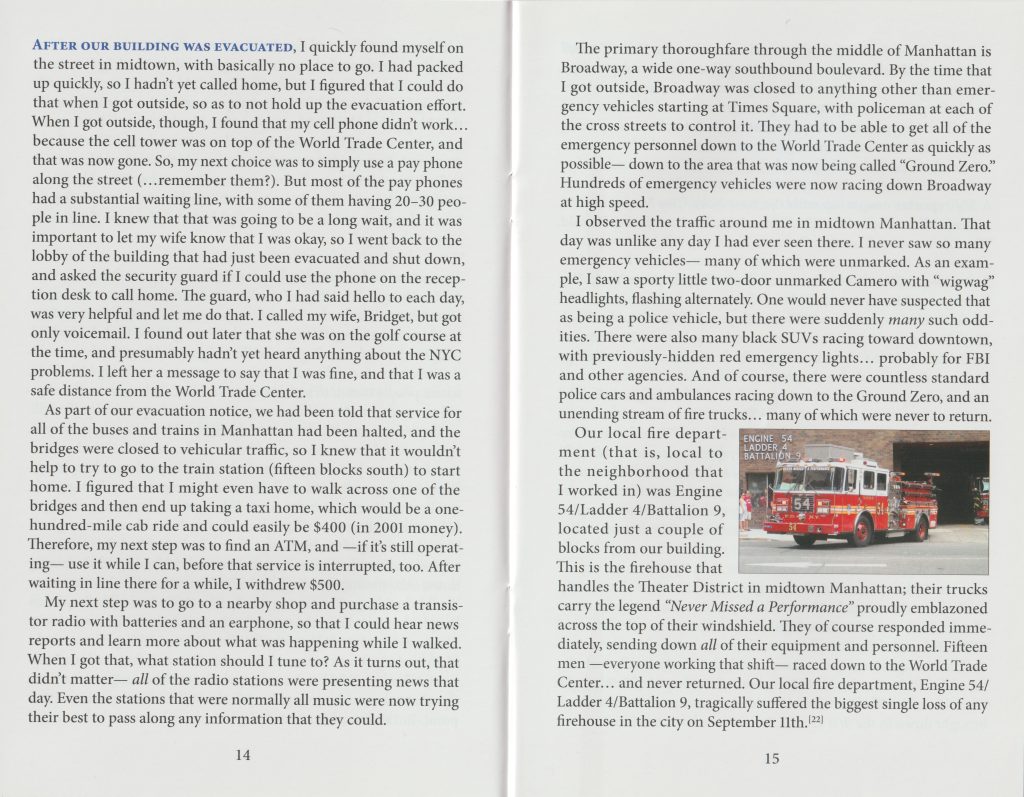
Our local fire department (that is, local to the neighborhood that I worked in) was Engine 54/Ladder 4/Battalion 9, located just a couple of blocks from our building. This is the firehouse that handles the Theater District in midtown Manhattan; their trucks carry the legend “Never Missed a Performance” proudly emblazoned across the top of their windshield. They of course responded immediately, sending down all of their equipment and personnel. Fifteen men – everyone working that shift – raced down to the World Trade Center… and never returned. Our local fire department, Engine 54/Ladder 4/Battalion 9, tragically suffered the biggest single loss of any firehouse in the city on September 11th.[22]
Realize that the loss of office workers within the Twin Towers wasn’t the full extent of the disaster. Firefighters from many companies throughout the area arrived on the scene, and many firefighters climbed up 80 stories by stairs to provide assistance. Many of them had a hundred pounds of equipment on their backs. Few of them made it back out of the buildings. Some fire stations lost everyone… all members (and also all firetrucks).
A TV reporter caught up with the New York City Mayor on 9/11 and asked him to predict what the final death toll might be, He said, “More than any of us can bear.”
A major complication that occurred was that the New York City Emergency Management Control Center was located inside the World Trade Center. From 1999 until September 11, 2001, New York City’s Emergency Operations Center was housed on the 23rd floor of the 7 World Trade Center building, which was one of the buildings that was also destroyed in the attacks.[23] The Secret Service also had their offices there. Other federal agencies in the building included the Defense Department and the CIA.[24] The 7 WTC building burned for most of the day and ultimately collapsed at 5:21 pm,[25] the first steel skyscraper known to have collapsed primarily due to uncontrolled fires.[26]
History.com reported, “Fires continued to burn in lower Manhattan for 99 days after the attack. Underground fires continued to burn for months. Every time a crane moved a large chunk of debris, the sudden rush of oxygen intensified the flames. Downtown Manhattan reeked of smoke and burning rubber, plastic and steel.”[27]
Just as a side story, a decade prior to 9/11, I had a business trip to the financial center in New York City and stayed at the Marriott Hotel, which was part of the World Trade Center complex; it was 3 WTC. The night that I stayed there, there were somehow three middle-of-the-night blaring fire alarms, with fire trucks loudly arriving for each incident. …An interesting but rather sleep-depriving night. Years later, the Marriott Hotel building was one of the buildings brought down in the 9/11 attacks. It has since been rebuilt.
Back to my wandering. I continued to plod aimlessly through midtown for a while, trying to decide on a plan of action – and like everyone else there, also trying to understand what was happening. I had been told that no trains were running, so I decided that I wasn’t going to be able to take the train home from my regular midtown station on 34th Street, but there is a fairly major station farther up in Manhattan, at 125th Street, so I thought that trains might come just that far into Manhattan and then go back. I tried for a while to get a taxi, but I couldn’t get one, so I decided to just walk up there.
I certainly do not mean to sound like “poor me” when other people are trapped and dying, but just to paint a picture, I was wearing a suit and tie and dress shoes (…I wear soft shoes now, even with a suit), and carrying my stupidly-heavy case with me, so walking was slow. But that was okay, and I was okay… I wasn’t in any danger.
All around me, there was a lot of chaos going on in the streets around me, but everyone was dealing with it; they were all just confused. Like me. The sidewalks were packed with pedestrians everywhere I went. Everybody was very somber, but always very friendly and helpful. If you have heard stories about gruff or rude New Yorkers, that wasn’t today.
There were a lot of odd sights around me. A tow truck went by with a dozen or more large U. S. flags on it, simply as a declaration that we’re all Americans, and we’re all in this together, against whoever is attacking us. And everyone was helping everyone.
I passed a bar along the way which had moved their TV out to the sidewalk, onto a card table, so that anyone passing by could see the unfolding news coverage.
I got up to 84th Street, which was really only a couple of miles away, but it seemed much longer. In this area, my cellphone was working again, and a call came in from a manager in the area where I worked. His main purpose in calling was to make sure that he could account for everyone’s safety. But then he added that he had a few other employees gathering at his apartment. Come and join us. This was below the numbered streets in Manhattan, so it’s 85+ blocks south of where I am now, a few miles away. …And also much closer to the World Trade Center.
I decided that it would be good to have a few others around and perhaps have some TV coverage, too, to figure out what to do next. That also sounded better than continuing to walk to a train station that might be closed, so I turned around and started walking south.
As I walked, I continued to try to hail a cab, and now that I was out of the most hectic midtown area, there was less demand for cabs, so this time I was successful. The cab driver was a very nice fellow, and commiserated with me about the terrible events of the day.
When we got back to midtown, traffic was chaotic and very slow, even by normal NYC standards – they couldn’t leave Manhattan. By the time that we had crawled down to 42nd Street, the cab driver turned to me and very apologetically told me that he was going to have to cancel the rest of the ride – if he didn’t get back to his garage and turn in his records by the end of the day, he wouldn’t get paid. I understood the problem. He pointed out a nearby bus stop which he said could take me right on down to my destination. The cab fare at that point was about $15, so I handed him a twenty – but he declined, saying that he wasn’t able to take me as far as I wanted to go, so there’s no charge.
Well, I had never had a cab driver say that before. This certainly wasn’t his fault and I knew that he was going to lose money on this trip, so I told him to just keep the twenty as a tip. He declined, even after several attempts on my part. That was the spirit of New York that I was seeing throughout the city that day. Everyone was doing what they could to help everyone else around them.
I went to the nearby bus stop that the taxi driver had shown me. Yes, that was the right bus. I got on with money in hand for the fare, but the driver had his hand over the top of the farebox… due to the emergency conditions of the day, it was free.
I found my manager’s apartment and settled in there with a couple of coworkers. It was good to have a chance to sit down after all of that walking. We watched the unbelievable news reports on TV for several hours. The plan arose to go over to an emergency rescue station that had been set up at Chelsea Piers and donate blood. This seemed like one thing that we could do to help and be part of this. But as we watched the TV coverage, we were told that no survivors were being brought in to that area.[28]
That was a dire and disturbing realization. Because of the risk of more attacks, possibly in the form of bombs, most major transportation channels in and out of Manhattan were closed. No one knew what might come next. They also needed to keep the bridges clear for emergency vehicles. There were also no trains and no subways. For the first time in over a century, boats were the only means of getting out of NYC.
Half-a-million people were evacuated from Manhattan by boats that day. It was the largest marine evacuation in history… even larger than Dunkirk. “The evacuation of New York included the largest sea evacuation in recorded history, with over 500,000 being evacuated in nine hours by hundreds of boats.”[29, 30]
People wanted to get onto a boat to get away from Manhattan; they didn’t even care where the boat was going. A few people were actually jumping into the water and swimming away from Manhattan.[31]
People could also walk across the bridges, and most of the bridges were completely packed shoulder-to-shoulder with pedetrians. But no vehicles were allowed on any of the bridges.
Homeward Bound
By mid-evening, we finally heard on the news that the trains were going to be running again after midnight, so at that point I thanked our host and left. I walked up to the train station on 34th Street; en route I passed a lot of areas in utter turmoil. The lower street were gray. The streets were covered in toxic dust, which was a very toxic mix of powdered concrete, lead, asbestos, glass fibers, and sadly, human remains from the collapsed buildings.[32, 33]
Trailer trucks carrying generators and massive spotlights were racing in with police escorts guiding them down to the site. And finally, about forty blocks north, I got to the train station.
My train finally left at 12:30 AM. …Homeward bound! I sat in the cafe car, as I usually did on my way home, so that I could share a table with others and visit along the way. The train ride that night was of course very somber. The events of the day seemed just too horrific and inhumane to comprehend.
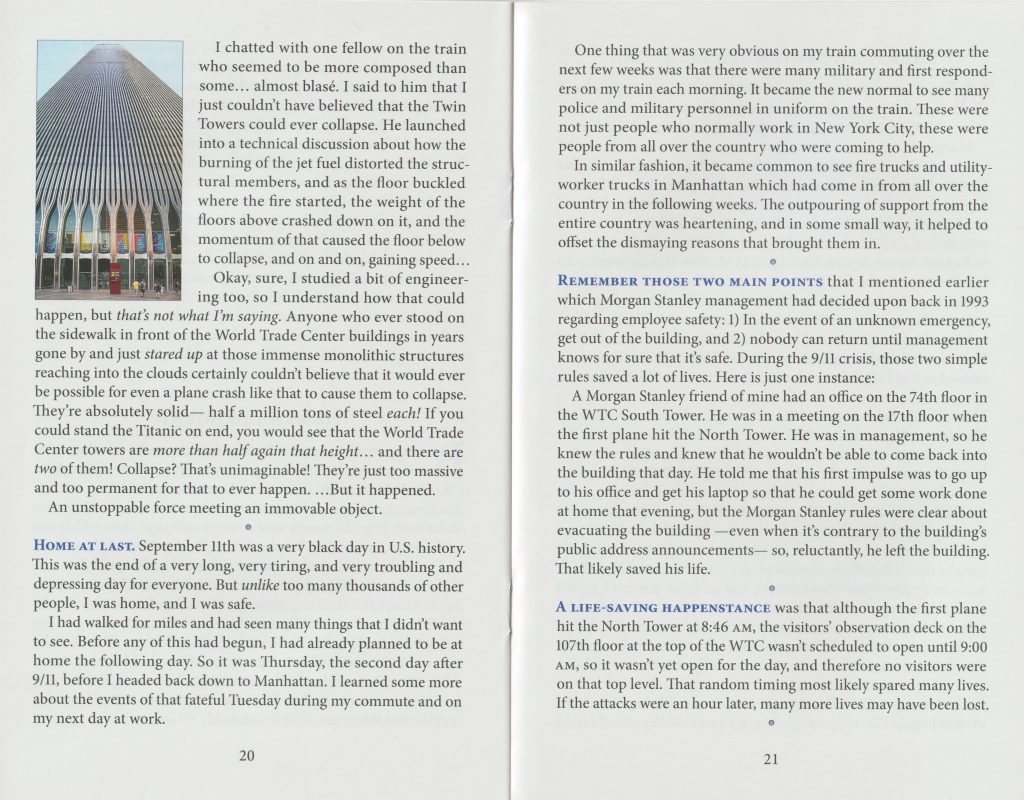
I chatted with one fellow on the train who seemed to be more composed than some… almost blasé. I said to him that I just couldn’t have believed that the Twin Towers could ever collapse. He launched into a technical discussion about how the burning of jet fuel distorted the structural members, and as a floor buckled where the fire started, the weight of the floors above crashed down on it, and the momentum of that caused the floor below to collapse, and on and on, gaining speed….
Okay, sure, I studied a bit of engineering too, so I understand how that could happen, but that’s not what I’m saying. Anyone who ever stood on the sidewalk in front of the World Trade Center buildings in years gone by and just stared up at those immense monolithic structures reaching into the clouds certainly couldn’t believe that it would ever be possible for even a plane crash like that to cause them to collapse. They’re absolutely solid – half a million tons of steel each! If you could stand the Titanic on end, you would see that the World Trade Center towers are more than half again that height… and there are two of them! Collapse? That’s unimaginable! They’re just too massive and too permanent for that to ever happen. …But it happened.
An unstoppable force meeting an immovable object.
Home at last. September 11th was a very black day in U.S. history. This was the end of a very long, very tiring, and very troubling and depressing day for everyone. But unlike too many thousands of other people, I was home, and I was safe.
I had walked for miles and had seen many things that I didn’t want to see. Before any of this had begun, I had already planned to be at home the following day. So it was Thursday, the second day after 9/11, before I headed back down to Manhattan. I learned some more about the events of that fateful Tuesday during my commute and on my next day at work.
One thing that was very obvious on my train commuting over the next few weeks was that there were many military and first responders on my train each morning. It became the new normal to see many police and military personnel in uniform on the train. These were not just people who normally work in New York City, these were people from all over the country who were coming to help.
In similar fashion, it became common to see fire trucks and utility-worker trucks in Manhattan which had come in from all over the country in the following weeks. The outpouring of support from the entire country was heartening, and in some small way, it helped to offset the dismaying reasons that brought them in.
Remember those two main points that I mentioned earlier which Morgan Stanley management had decided upon back in 1993 regarding employee safety: 1) In the event of an unknown emergency, get out of the building, and 2) nobody can return until management knows for sure that it’s safe. During the 9/11 crisis, those two simple rules saved a lot of lives. Here is just one instance:
A Morgan Stanley friend of mine had an office on the 74th floor in the WTC South Tower. He was in a meeting on the 17th floor when the first plane hit the North Tower. He was in management, so he knew the rules and knew that he wouldn’t be able to come back into the building that day. He told me that his first impulse was to go up to his office and get his laptop so that he could get some work done at home that evening, but the Morgan Stanley rules were clear about evacuating the building – even when it’s contrary to the building’s public address announcements – so, reluctantly, he left the building. That likely saved his life.
A life-saving happenstance was that although the first plane hit the North Tower at 8:46 AM, the visitor’s observation deck on the 107th floor at the top of the WTC wasn’t scheduled to open until 9:00 AM, so it wasn’t yet open for the day, and therefore no visitors were on that top level. That random timing most likely spared many lives. If the attacks were an hour later, many more lives may have been lost.
Thursday, September 13th, 2001
When I got back to work in Manhattan on the second day after the attack, I of course purchased (and saved) copies of several of the NYC newspapers. Some of them are quoted here.
Morgan Stanley was the largest tenant in the South Tower,[34] which was the second tower to be hit. On that fateful day, while the Port Authority was saying stay put, Rick Rescorla ran from floor to floor in the South Tower on 9/11, yelling for everyone to get out now! He did such a remarkable job of clearing the offices that he is credited with saving 2,687 lives on September 11th.[35, 36] In the end, thanks to Rescorla’s truly heroic efforts, just 13 Morgan Stanley employees lost their lives in the South Tower. …Tragically, he was one of them. When the South Tower collapsed, Rick was still in the building, making sure that no one was left behind. His body was never found.
As well as being featured in a History Channel movie,[13] Rick Rescorla was also the source of an opera, “Heart of a Soldier,” which opened in San Francisco on the 10th Anniversary of 9/11.[37, 38]
With all of the turmoil and confusion going on, how does a company like Morgan Stanley know who made it out? The first step was for the managers to phone everyone – just as my manager called me while I was walking up toward the distant train station on 9/11. Another step was to track credit card usage: Morgan Stanley created and operates the Discover Card, and employees used it for business purchases and business travel. They therefore had a way to quickly check its usage on 9/11, and since it was issued for business use, it wouldn’t likely be used by family members. If an employee’s card was used, that didn’t necessarily prove that the employee was safe, but it was a hopeful and likely sign in that direction. Of course, if the card wasn’t used, that was simply an unknown status. With everyone doing what they could to get out of Manhattan, a lot of credit cards were being used that day, sometimes for cash withdrawals for travel, just as I did.
On 9/13, the New York Times spoke of the day following 9/11, under the heading, “A City of Quiet: Nothing Is Same One Day After,” saying that “New York woke up to another day yesterday, but it wasn’t another day. It couldn’t possibly be. It was a city of less. Less traffic, less noise, fewer people, less activity, less movement, less certainty, less joy.”[39] And it was odd to see the iconic stock exchange tape on the side of the Morgan Stanley building reporting no stock trades.[40]
In the next few days following 9/11, I thought a lot about emergencies occurring, and wondered how I would exit from my own building; remember that I was on the 33rd floor. So one day at lunchtime, I practiced an emergency exit from our building by walking down the staircase. I wanted to see how long it would take, and see if there were any obstacles, such as a locked door at the bottom… and no, it was all clear.
Of course, I didn’t have to contend with hundreds of other people on the same staircase; other than myself, the staircase was empty. Keeping to a normal pace, I found that I was able to walk down about three floors per minute, so leaving my building took about 11 minutes with no one else on the staircase. I considered that to be a successful practice test and good information. But with crowds evacuating the WTC, it took some people over an hour to go that number of floors.
One might think that walking down the stairs should be very easy and problem-free, but in reality, our bodies are just not made for that (well, mine isn’t, at least) so the next day, I was very sore.
Over the previous few years, my train ride home had usually been a fairly social event, with a group of us meeting in the Amtrak Cafe Car to chat over coffee. Following the 9/11 event, we of course shared any information that we had about anyone who may have been in the towers. One fellow that we knew was Ed, who was in charge of physical security for the World Trade Center. Of course, no badge readers or metal detectors could have helped us on that day. But where is Ed? Did he make it out? He was no longer on the train. Two days later, we saw Ed’s car still sitting in the parking lot at the train station.
Although I only knew Ed from our train visits, he had become a friend, a member of our “train gang,” and I was concerned about him. I finally mustered up the courage to call Ed’s house. His wife answered. Oh, where to start? – I rather clumsily choked out the words that I knew Ed from our train commutes… she stopped me and said, “Ed is here. Do you want to speak with him?” It was a tearful moment for me, but a great relief.
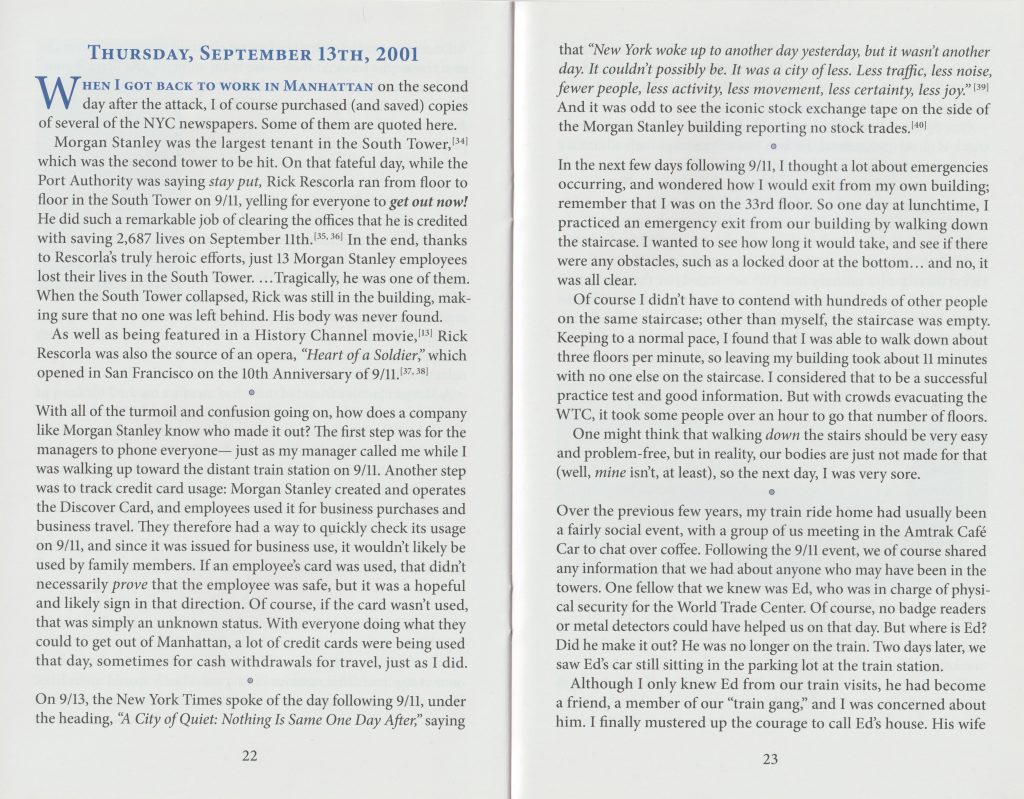
One of the friends that we would see on the evening train ride was a U. S. Army General. He was one of the ones with whom we had these daily discussions on the ride home. One evening, a young woman who we didn’t know joined our table in the cafe car. As conversation proceeded, she told us that she didn’t believe any of this. What? How can you possibly think that? We pointed out the military fighter jets which were now circling and keeping watch over New York City… why do you think they are there? She said that’s just a story; there are no military jets. (We reminded her that she would have to look up to see them.) We pointed out that the gentleman sitting beside us here is a General. He wasn’t in uniform, and she felt that we were just making that up. So just to appease her, he showed her his military ID; she laughed at it, and said, well, that’s a fake.
We only saw her that one evening, but she was of course a topic of discussion and a source of headshaking amongst us on subsequent evening commutes. We never knew her name, so she just became Snickerdoodle in our conversations.
She was a personification of the idea that you can lead a horse to water, but you can’t make them think.
I mentioned earlier that Morgan Stanley had been putting up a new building across the street from my building, and just a block away from our headquarters building. A few months earlier, I had the privilege of taking an insider’s “hard-hat” tour of the building while it was under construction. The building had a lot of impressive innovations, including safety features such as the staircases being wider as they went down, to allow for more people if an emergency were ever to occur. That new building had been under construction for three years; construction was almost finished, and the building was just about to open. Immediately after the 9/11 disaster, Morgan Stanley put the building up for sale. It was sold the next day. Their feeling was that they didn’t want to ever have such a large concentration of employees in one geographic location. For the sake of safety, they wanted their employees to be more dispersed.
Immediately following the disaster, paperwork was circulated to all of the employees at Morgan Stanley, citing a 100% loss of everything at the World Trade Center, and asking if any of us had any other claims there. The idea of a 100% loss startled me. Even after a calamity such as a major earthquake there are often things that can be salvaged… but not here.
I heard someone ask why the World Trade Center wasn’t built stronger, so that it could handle the impact that it was given? The architect of the towers, Minoru Yamasaki, pointed out that each building did its job by lasting long enough for those who were able to get out to do so. From the New York Times on 9/13: “After a terrorist bombing of the World Trade Center in 1993, Leslie E. Robertson, one of the structural engineers involved in the original design of the towers, said they had been designed to withstand the impact of a fully fueled Boeing 707. The jets that struck on Tuesday were about half again as large.” These were wide-body airliners, weighing about 400,000 pounds each, and they were fully fueled for a transcontinental trip.[41, 42]
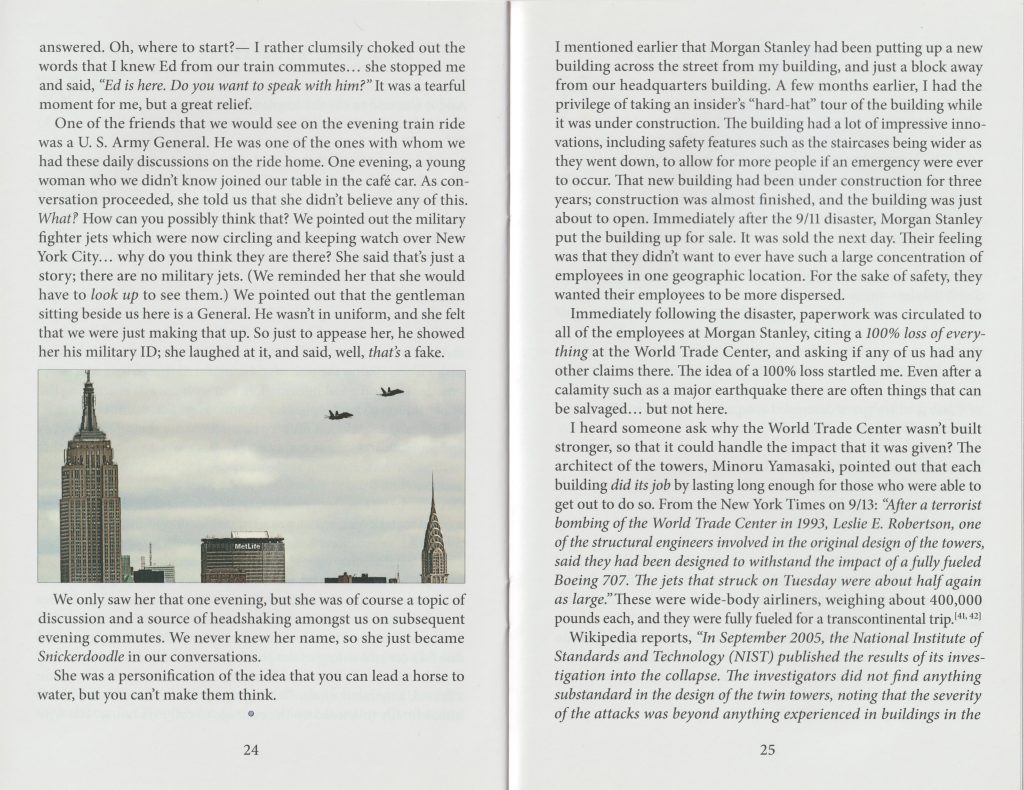
Wikipedia reports, “In September 2005, the National Institute of Standards and Technology (NIST) published the results of its investigation into the collapse. The investigators did not find anything substandard in the design of the twin towers, noting that the severity of the attacks was beyond anything experienced in buildings in the past. They determined the fires to be the main cause of the collapses, finding that sagging floors pulled inward on the perimeter columns, causing them to bow and then to buckle. Once the upper section of the building began to move downwards, a total progressive collapse was unavoidable.”[25]
For those unfortunate people who happened to be on the floors above the impact points, there was nothing that could be done, as the elevators and staircases had been severed, and the very dense smoke made helicopter rescue from the roof impossible.
When all was said and done, it took ten years to build the towers and ten seconds for them to fall. They stood from 1973 to 2001.
Although I was fortunate to have not seen it, there is an estimate that over 200 people jumped or fell to their death in the North and South Towers – many of them not to save themselves, but to end their lives quickly, rather than burning in the inferno inside the building.[43]
The 9/11 disaster in New York City wasn’t limited to just the Twin Towers. Seven buildings in the WTC complex collapsed, with twelve more buildings sustaining major damage. The 13-million square feet of Class A office space destroyed is equal to the entire office-space inventory of Atlanta or Miami.[44]
Fresh Kills: Debris from the 9/11 site was taken to the Fresh Kills landfill facility on Staten Island in New York City, which had been New York City’s principal landfill. About 1.6 million tons of material obtained from Ground Zero was taken to the landfill for sorting. Trucks brought in general rubble, building parts, and aircraft parts… and inevitably, some human remains. According to the medical examiner’s office, 2,753 people who were in the World Trade Center area died in the terror attacks. Of those, 1,634 have been identified; 1,119 have not.[45]
The unfortunate name of the Fresh Kills area has nothing to do with the 9/11 disaster. “Kill” is taken from the Dutch “kille” which means “stream,” so this area of fresh streams used to be seen as having a tranquil, soothing name. Seeing that name in the news each day following 9/11 put it in a different light.
Summarizing the Attacks
Here is what happened on 9/11: On September 11, 2001, at 8:45 AM on a clear Tuesday morning, an American Airlines Boeing 767 loaded with 20,000 gallons of jet fuel crashed into the north tower of the World Trade Center in New York City.
The impact left a gaping, burning hole near the 80th floor of the 110-story skyscraper, instantly killing hundreds of people (including everyone on the plane) and trapping hundreds more on higher floors.
As the evacuation of the North Tower and its twin got underway, television cameras broadcasted live images of what initially appeared to be a freak accident. Then, 18 minutes after the first plane hit, a second Boeing 767, United Airlines Flight 175, appeared out of the sky, turned sharply toward the World Trade Center and sliced into the South Tower near the 60th floor.
The collision caused a massive explosion that showered burning debris over surrounding buildings and onto the streets below. It immediately became clear that America was under attack.[46]
A group of 19 militant extremist Islamic terrorists boarded four commercial planes flying out of Boston, JFK, and Dulles airports, which were chosen purposely to be on cross-country routes so that they would be carrying their maximum fuel load. They hijacked these planes using just box-cutters as weapons – no guns and no real knives, just something that a contractor might use. No one thought to consider box-cutters as weapons back then, so no one stopped them from boarding the planes. The FAA tightened the rules the next day, on September 12th.[47]
A short time into the flight, the terrorists sprang into action. Their first step was to brutally murder one or more of the passengers using the box-cutters, in order to force the other passengers into submission. Those other passengers, of course, had no idea of what was coming next. I imagine they felt that if they complied, they’d be okay.
Once the terrorists took control of the planes, they flew the first three of them on suicide missions: one into each of the World Trade Center towers and one into the Pentagon.
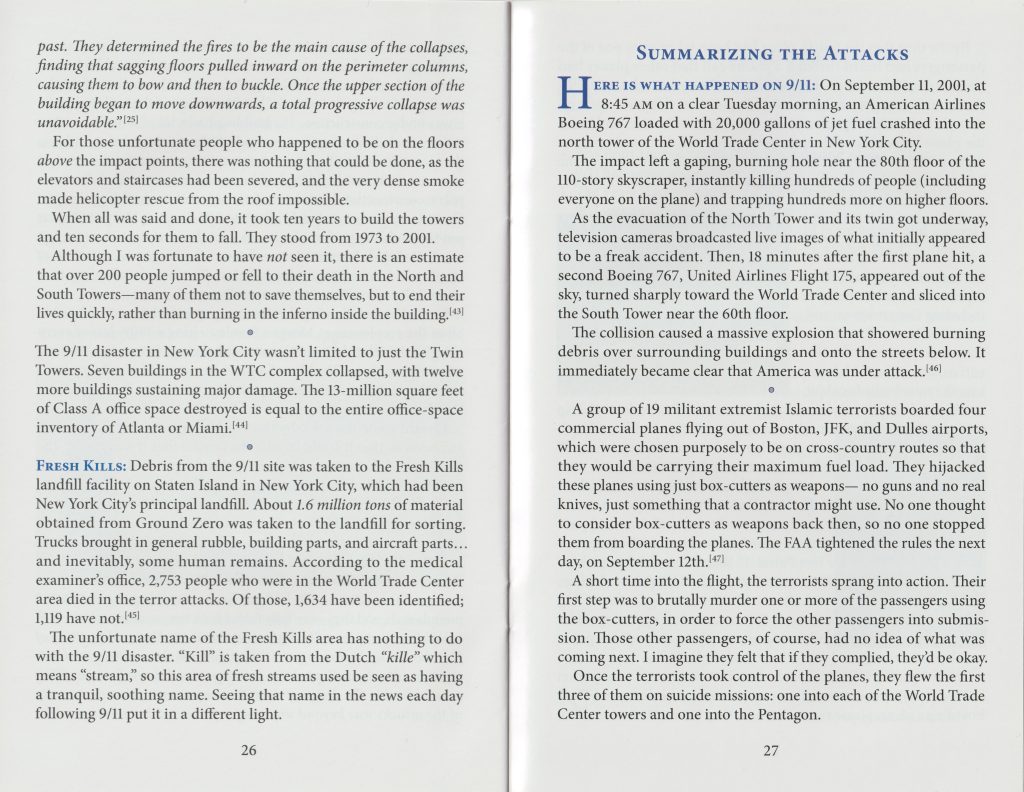
By the time that the fourth plane had been taken over, one of the passengers had heard through a phone call that the other planes had been on a suicide mission. It was never determined conclusively what the intended target was of that fourth plane, as the passengers on that plane banded together to overpower the terrorists and crash the plane before it could reach its target – which, based upon its flight path, was likely to be either the U.S. Capitol Building or the White House. These heroic passengers knew by this time that they were going to die whether they attacked the terrorists or simply sat in their seats and did nothing. So they bravely took action, and in doing so, they undoubtedly saved the lives of hundreds of other people, including Congressmen, and potentially, the President. They overpowered the terrorists, but still couldn’t get into the now-locked cockpit, so ultimately, in the mayhem, that plane crashed in the reclaimed strip mine in Shanksville, Pennsylvania, and not in the middle of Washington, DC. That field is now the Flight 93 National Memorial site.[48]
Of the 2,977 victims killed in the September 11 attacks, 412 were emergency workers who responded to the WTC attacks. This includes 343 firefighters of the New York City Fire Department; 60 police officers, and eight emergency medical technicians and paramedics from private emergency medical services, and one patrolman from the New York Fire Patrol.[49] Several hundred more have died of 9/11-related illnesses since then, and 422,000 New Yorkers suffered from post-traumatic-stress disorder as a result of 9/11.[50]
It’s a terrible irony that these al-Qaeda terrorists, operating under Osama bin Laden, managed to use our own planes as weapons against us. They effectively used our jetliners as bombs.[51, 52]
These days, if you get bothered when TSA confiscates your pocket knives or drill bits or screwdrivers or scissors or corkscrews before boarding a plane, please remember how they learned to be so careful.
Epilogue
Over the years, I have heard some people liken the 9/11 attacks to the Pearl Harbor attack (December 7th, 1941), but in my mind, they are quite different.
The Pearl Harbor attack took place during a time of war – 9/11 happened during peacetime.
The Pearl Harbor attack took place against a military base – 9/11 was an attack against civilians.
The 9/11 attacks killed about one third more people and injured 5-6 times more people than the attack against Pearl Harbor.
My comments here certainly aren’t meant to downplay or belittle the terrible loss of life at Pearl Harbor in any way. That event was tragic. I am simply trying to put the horrific atrocities of 9/11 into some sort of perspective.
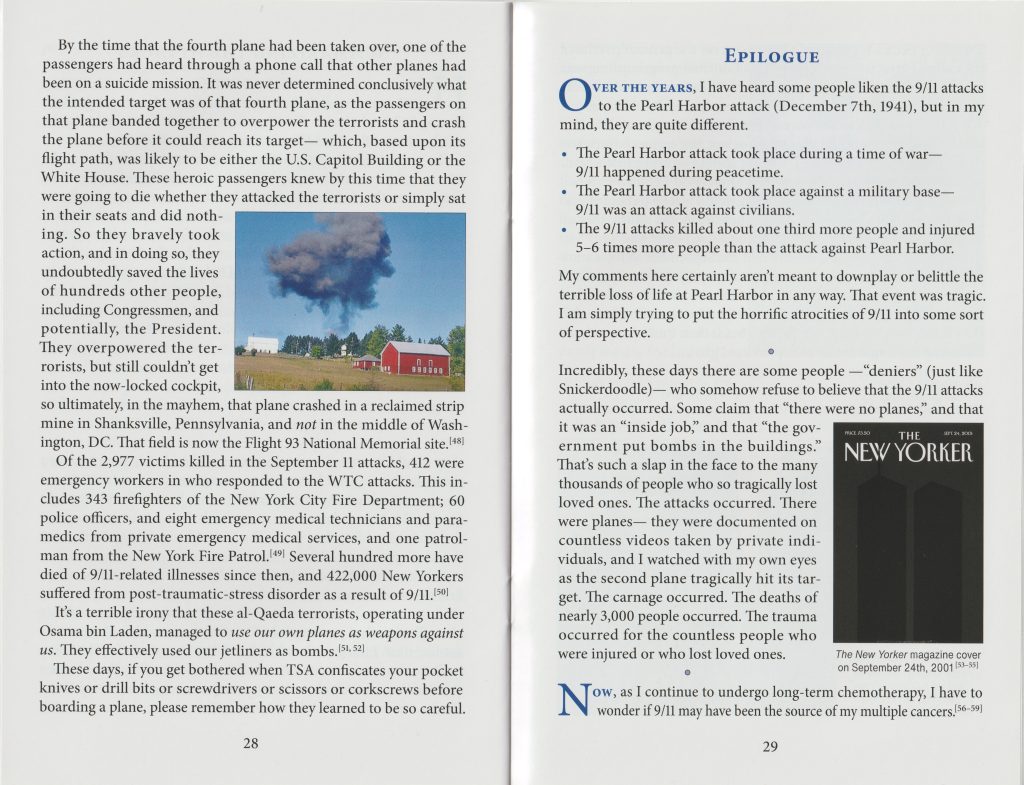
Incredibly, these days there are some people – “deniers” (just like Snickerdoodle) – who somehow refuse to believe that the 9/11 attacks actually occurred. Some claim that “there were no planes,” and that it was an “inside job,” and that “the government put bombs in the buildings.” That’s such a slap in the face to many thousands of people who so tragically lost loved ones. The attacks occurred. There were planes – they were documented on countless videos taken by private individuals, and I watched with my own eyes as the second plane tragically hit its target. The carnage occurred. The deaths of nearly 3,000 people occurred. The trauma occurred for the countless people who were injured or who lost loved ones.
Picture Caption: The New Yorker magazine cover on September 24, 2001.[53-55]
Now, as I continue to undergo long-term chemotherapy, I have to wonder if 9/11 may have been the source of my multiple cancers.[56-59]
These attacks had such an impact on the general psyche of the country that television coverage of normal programming was curtailed for quite a while – not so that the networks could devote more time to 9/11 coverage, but because everyone felt that it was just “too soon” to go back to our normal frivolous TV programs. Whether you had lost loved ones in the attacks or not, the entire country was in mourning. This TV hiatus lasted for about two and a half weeks.
Late night shows such as Jay Leno and David Letterman relied heavily on humor, and it was felt that it would just be out of place to continue with that for a while. When they finally did return, they all seemed to be “treading carefully,” trying to find their way.
When The Tonight Show returned on September 18th, a moving musical number that was presented was “Half Your Angels,”[60] performed live by David Crosby and Graham Nash. It’s a slow and hauntingly beautiful song that was written by Graham Nash after the Oklahoma City bombing in 1995, but it then took on new focus following the tragic events of September 11th:
Somewhere in heaven
Wings are taking flight
Flying over a worldly weight of hatred
Hanging over a building in the rain
You got to heaven blown across the sky
Crying out for the angels to help you
To rise up out of the ashes and the flames
Send me half your angels
We’re running out of time
Send me half your angels
I’ll send you half of mine
Hope they get there in time
And far below your heaven
Hearts are wondering why
Why would anyone hurt God’s children?
How could anyone harm them at all?
Send me half your angels
We’re running out of time
Send me half your angels
I’ll send you half of mine
Hope they get there in time
And while you’re in heaven weeping on the wind
Ask your heart to forgive this evil
Ask your soul to forgive us all
Send me half your angels
We’re running out of time
Send me half your angels
I’ll send you half of mine
Send me half your angels
We’re running out of time
Send me half your angels
I’ll send you half of mine
Hope they got there in time
…Half your angels, goodbye…
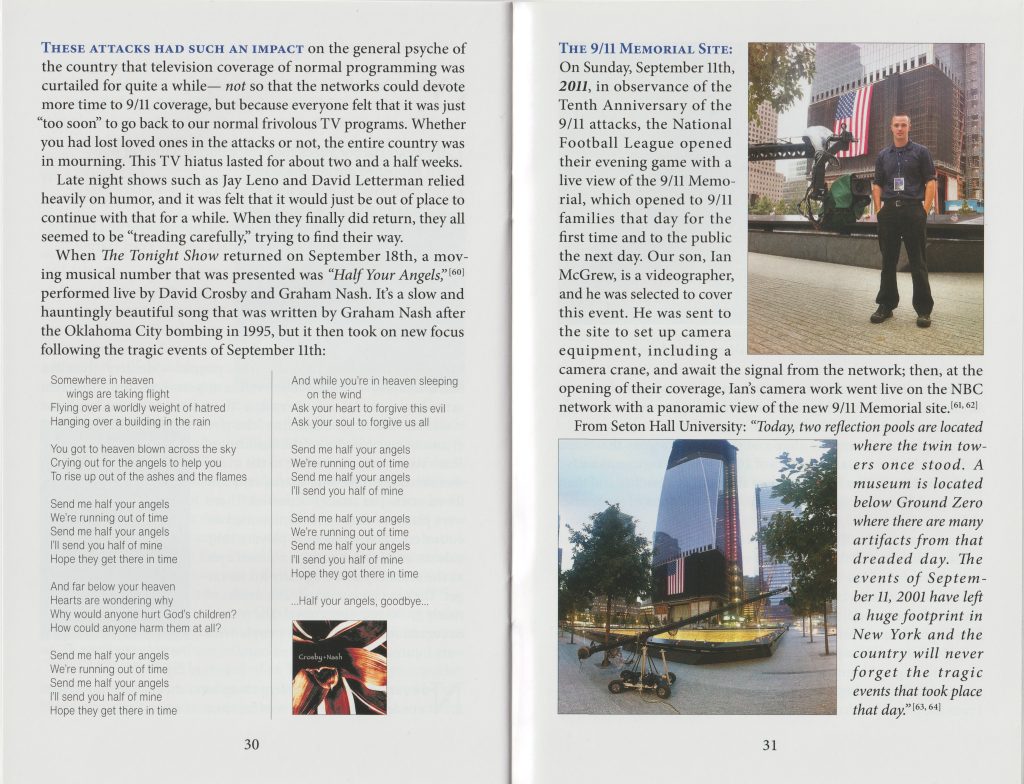
The 9/11 Memorial Site: On Sunday, September 11th, 2011, in observance of the Tenth Anniversay of the 9/11 attacks, the National Football League opened their evening game with a live view of the 9/11 Memorial, which opened to 9/11 families that day for the first time and to the public the next day. Our son, Ian McGrew, is a videographer, and he was selected to cover this event. He was sent to the site to set up camera equipment, including a camera crane, and await the signal from the network; then, at the opening of their coverage, Ian’s camera work went live on the NBC network with a panoramic view of the new 9/11 Memorial site.[61, 62]
From Seton Hall University: “Today, two reflection pools are located where the twin towers once stood. A museum is located below Ground Zero where there are many artifacts from that dreaded day. The events of September 11, 2001 have left a huge footprint in New York and the country will never forget the tragic events that took place that day.”[63, 64]
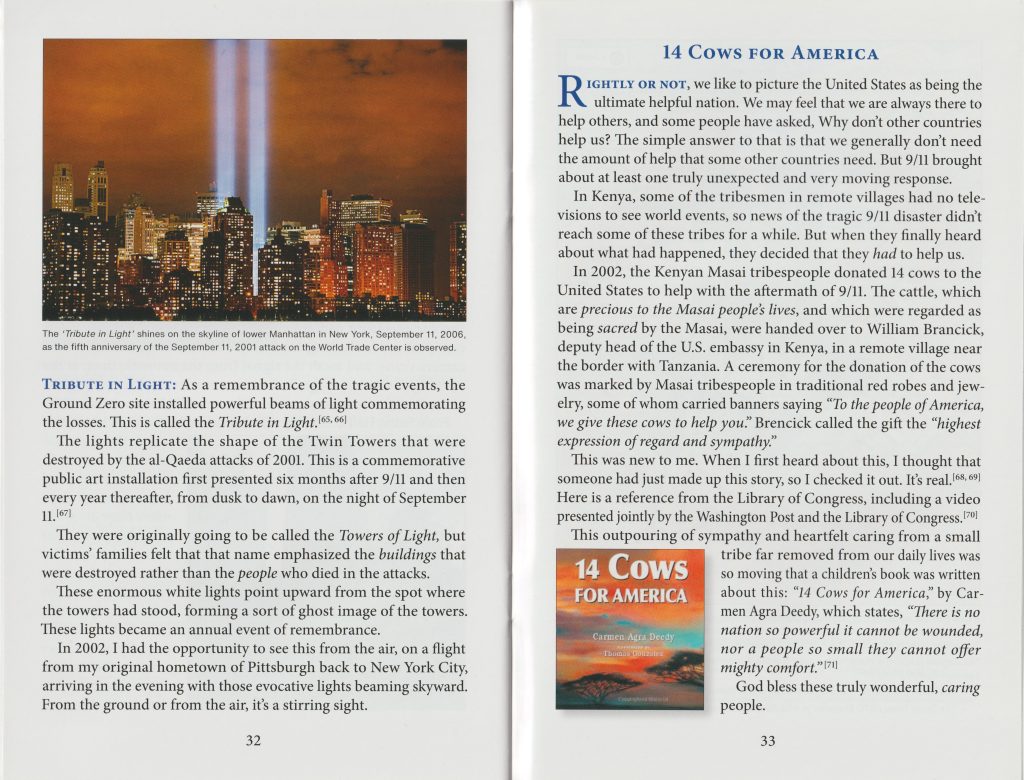
Picture Caption: The “Tribute in Light” shines on the skyline of lower Manhattan in New York, September 11, 2006, as the fifth anniversary of the September 11, 2001 attack on the World Trade Center is observed.[65, 66]
Tribute in Light: As a remembrance of the tragic events, the Ground Zero site installed powerful beams of light commemorating the losses. This is called the Tribute of Light.[67]
The lights replicated the shape of the Twin Towers that were destroyed by the al-Qaeda attacks of 2001. This is a commemorative public art installation first presented six months after 9/11 and then every year thereafter, from dusk to dawn, on the night of September 11.
They were originally going to be called the Towers of Light, but victims’ families felt that that name emphasized the buildings that were destroyed rather than the people who died in the attacks.
Those enormous white lights point upward from the spot where the towers had stood, forming a sort of ghost image of the towers. These lights became an annual event of remembrance.
In 2002, I had the opportunity to see this from the air, on a flight from my original hometown of Pittsburgh back to New York City, arriving in the evening with those evocative lights beaming skyward. From the ground or from the air, it’s a stirring sight.
14 Cows for America
Rightly or not, we like to picture the United States as being the ultimate helpful nation. We may feel that we are always there to help others, and some people have asked, Why don’t other countries help us? The simple answer to that is that we generally don’t need the amount of help that some other countries need. But 9/11 brought about at least one truly unexpected and very moving response.
In Kenya, some of the tribesmen in remote villages had no televisions to see world events, so news of the tragic 9/11 disaster didn’t reach some of these tribes for a while. But when they finally heard aobut what had happened, they decided that they had to help us.
In 2002, the Kenyan Masai tribespeople donated 14 cows to the United States to help with the aftermath of 9/11. The cattle, which are precious to the Masai people’s lives, and which were regarded as being sacred by the Masai, were handed over to William Brancick, deputy head of the U.S. embassy in Kenya, in a remote village near the border with Tanzania. A ceremony for the donation of the cows was marked by Masai tribespeople in traditional red robes and jewelry, some of whom carried banners saying, “To the people of America, we give these cows to help you.” Brencick called the gift the “highest expression of regard and sympathy.”
This was new to me. When I first heard about this, I thought that someone had just made up this story, so I checked it out. It’s real.[68, 69] Here is a reference from the Library of Congress, including a video presented jointly by the Washington Post and the Library of Congress.[70]
This outpouring of sympathy and heartfelt caring from a small tribe far removed from our daily lives was so moving that a children’s book was written about this: “14 Cows for America,” by Carmen Agra Deedy, which states, “There is no nation so powerful it cannot be wounded, nor a people so small they cannot offer mighty comfort.”[71]
God bless these truly wonderful, caring people.
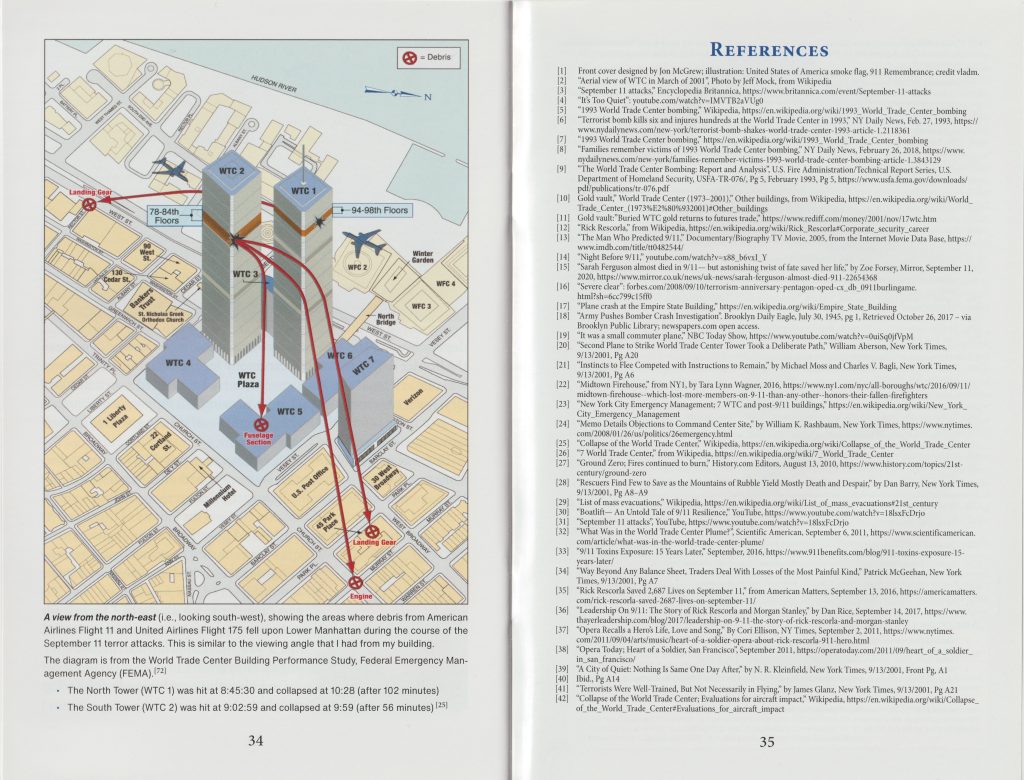
A view from the north-east (i.e., looking south-west), showing the areas where debris from American Airlines Flight 11 and United Airlines Flight 175 fell upon Lower Manhattan during the course of the September 11 terror attacks. This is similar to the viewing angle that I had from my building.
The diagram is from the World Trade Center Building Performance Study, Federal Emergency Management Agency (FEMA).[72]
The North Tower (WTC 1) was hit at 8:45:30 and collapsed at 10:28 (after 102 minutes).
The South Tower (WTC 2) was hit at 9:02:59 and collapsed at 9:59 (after 56 minutes).[25]
References
[1] Front cover designed by Jon McGrew; illustration: United States of America smoke flag, 911 Remembrance; credit vladm.
[2] “Aerial view of WTC in March of 2001”, Photo by Jeff Mock, from Wikipedia
[3] “September 11 attacks,” Encyclopedia Britannica, https://www.britannica.com/event/September-11-attacks
[4] “It’s Too Quiet”: youtube.com/watch?v=IMVTB2aVUg0
[5] “1993 World Trade Center bombing,” Wikipedia, https://en.wikipedia.org/wiki/1993_World_Trade_Center_bombing
[6] “Terrorist bomb kills six and injures hundreds at the World Trade Center in 1993,” NY Daily News, Feb. 27, 1993,https://www.nydailynews.com/new-york/terrorist-bomb-shakes-world-trade-center-1993-article-1.2118361
[7] “1993 World Trade Center bombing,” https://en.wikipedia.org/wiki/1993_World_Trade_Center_bombing
[8] “Families remember victims of 1993 World Trade Center bombing,” NY Daily News, February 26, 2018, https://www.nydailynews.com/new-york/families-remember-victims-1993-world-trade-center-bombing-article-1.3843129
[9] “The World Trade Center Bombing: Report and Analysis”, U.S. Fire Administration/Technical Report Series, U.S. Department of Homeland Security, USFA-TR-076/, Pg 5, February 1993, Pg 5, https://www.usfa.fema.gov/downloads/pdf/publications/tr-076.pdf
[10] Gold vault,” World Trade Center (1973-2001),” Other buildings, from Wikipedia, https://en.wikipedia.org/wiki/World_Trade_Center_(1973%E2%80%932001)#Other_buildings
[11] Gold vault:”Buried WTC gold returns to futures trade,” https://www.rediff.com/money/2001/nov/17wtc.htm
[12] “Rick Rescorla,” from Wikipedia, https://en.wikipedia.org/wiki/Rick_Rescorla#Corporate_security_career
[13] “The Man Who Predicted 9/11, Documentary/Biography TV Movie, 2005, from the Internet Movie Data Base, https:// www.imdb.com/title/tt0482544/
[14] “Night Before 9/11, youtube.com/watch?v=x88_b6vxl_Y
[15] “Sarah Ferguson almost died in 9/11— but astonishing twist of fate saved her life,” by Zoe Forsey, Mirror, September 11, 2020, https://www.mirror.co.uk/news/uk-news/sarah-ferguson-almost-died-911-22654368
[16] “Severe clear”: forbes.com/2008/09/10/terrorism-anniversary-pentagon-oped-cx_db_0911burlingame.html?sh=6cc799c15ff0
[17] “Plane crash at the Empire State Building,” https://en.wikipedia.org/wiki/Empire_State_Building
[18] “Army Pushes Bomber Crash Investigation”. Brooklyn Daily Eagle, July 30, 1945, pg 1, Retrieved October 26, 2017 – via Brooklyn Public Library; newspapers.com open access.
[19] “It was a small commuter plane,” NBC Today Show, https://www.youtube.com/watch?v=0uiSq0jfVpM
[20] “Second Plane to Strike World Trade Center Tower Took a Deliberate Path,” William Aberson, New York Times, 9/13/2001, Pg A20
[21] “Instincts to Flee Competed with Instructions to Remain, by Michael Moss and Charles V. Bagli, New York Times, 9/13/2001, Pg A6
[22] “Midtown Firehouse,” from NY1, by Tara Lynn Wagner, 2016, https://www.nyl.com/nyc/all-boroughs/wtc/2016/09/11/midtown-firehouse—which-lost-more-members-on-9-11-than-any-other–honors-their-fallen-firefighters
[23] “New York City Emergency Management; 7 WTC and post-9/11 buildings, https://en.wikipedia.org/wiki/New_York_City_Emergency_Management
[24] “Memo Details Objections to Command Center Site,” by William K. Rashbaum, New York Times, https://www.nytimes.com/2008/01/26/us/politics/26emergency.html
[25] “Collapse of the World Trade Center,” Wikipedia, https://en.wikipedia.org/wiki/Collapse_of_the_World_Trade_Center
[26] “7 World Trade Center,” from Wikipedia, https://en.wikipedia.org/wiki/7_World_Trade_Center
[27] “Ground Zero; Fires continued to burn,” History.com Editors, August 13, 2010, https://www.history.com/topics/21st-century/ground-zero
[28] “Rescuers Find Few to Save as the Mountains of Rubble Yield Mostly Death and Despair, by Dan Barry, New York Times, 9/13/2001, Pg A8-A9
[29] “List of mass evacuations,” Wikipedia, https://en.wikipedia.org/wiki/List_of_mass_evacuations#21st_century
[30] “Boatlift— An Untold Tale of 9/11 Resilience,” YouTube, https://www.youtube.com/watch?v=18lsxFcDrjo
[31] “September 11 attacks”, YouTube, https://www.youtube.com/watch?v=18lsxFcDrjo
[32] “What Was in the World Trade Center Plume?”, Scientific American, September 6, 2011, https://scientificamerican.com/article/what-was-in-the-world-trade-center-plume/
[33] “9/11 Toxins Exposure: 15 Years Later,” September, 2016, https://www.911benefits.com/blog/911-toxins-exposure-15-years-later/
[34] “Way Beyond Any Balance Sheet, Traders Deal With Losses of the Most Painful Kind,” Patrick McGeehan, New York Times, 9/13/2001, Pg A7
[35] “Rick Rescorla Saved 2,687 Lives on September 11,” from American Matters, September 13, 2016,https://americanmatters.com/rick-rescorla-saved-2687-lives-on-september-11/
[36] “Leadership On 9/11: The Story of Rick Rescorla and Morgan Stanley, by Dan Rice, September 14, 2017, https://www.thayerleadership.com/blog/2017/leadership-on-9-11-the-story-of-rick-rescorla-and-morgan-stanley
[37] “Opera Recalls a Hero’s Life, Love and Song,” By Cori Ellison, NY Times, September 2, 2011, https://www.nytimes.com/2011/09/04/arts/music/heart-of-a-soldier-opera-about-rick-rescorla-911-hero.html
[38] “Opera Today; Heart of a Soldier, San Francisco, September 2011, https://operatoday.com/2011/09/heart_of_a_soldier_in_san_francisco/
[39] “A City of Quiet: Nothing Is Same One Day After, by N. R. Kleinfield, New York Times, 9/13/2001, Front Pg, A1
[40] Ibid, Pg A14
[41] “Terrorists Were Well-Trained, But Not Necessarily in Flying,” by James Glanz, New York Times, 9/13/2001, Pg A21
[42] “Collapse of the World Trade Center; Evaluations for aircraft impact, Wikipedia, https://en.wikipedia.org/wiki/Collapse_of_the_World_Trade_Center#Evaluations_for_aircraft_impact
[43] “24 powerful and moving photos from the September 11 attacks that Americans will never forget,” from Business Insider, by Matthew DeBond, September 11, 2018, https://www.businessinsider.com/haunting-photos-from-september-11th-attacks-2016-9
[44] “9/11 anniversary: What was lost in the damage,” compiled by Sarah Bridge and Kazi Stastna, CBC News (Canada); posted Aug 21, 2011, https://www.cbc.ca/news/world/9-11-anniversary-what-was-lost-in-the-damage-1.1123528
[45] “12 years after, WTC debris still sifted for remains,” by Melanie Eversley, April 6, 2013, USA Today,https://www.usatoday.com/story/news/nation/2013/04/06/world-trade-center-debris/2058763/
[46] “September 11 Attacks,” The History Channel, https://www.history.com/topics/21st-century/9-11-attacks
[47] “F.A.A. Announces Stricter Rules; Knives No Longer Allowed,” by Paul Zielbauer with John Sullivan, New York Times, 9/13/2001, Pg A5
[48] “The Story of 9/11 and United Flight 93,” Friends of Flight 93 National Memorial, Photo by Val McClatchey, https://www.flight93friends.org/flight-93-story
[49] “Emergency workers killed in the September 11 attacks,”https://en.wikipedia.org/wiki/Emergency_workers_killed_in_the_September_11_attacks
[50] “9/11 by the Numbers,” New York Magazine, September 2014, https://nymag.com/news/articles/wtc/1year/numbers.htm
[51] CNN Transcripts, Interview with Peter Lance, aired September 4, 2003, https://www.cnn.com/TRANSCRIPTS/0309/04/se.19.html
[52] “Improved security has made airline hijackings rare,” Chicago Sun-Times, Bart Jansen, March 30, 2016, https://www.pressreader.com/usa/chicago-sun-times/20160330/281895887379206
[53] “The Uncredited Collaboration Behind The New Yorker’s Iconic 9/11 Cover,” By Jeet Heer, September 11, 2013, The Atlantic, https://www.theatlantic.com/entertainment/archive/2013/09/the-uncredited-collaboration-behind-em-the-new-yorker-em-s-iconic-9-11-cover/279563/
[54] “9/11/2001”, Cover of The New Yorker magazine, Wikipedia, https://en.wikipedia.org/wiki/The_New_Yorker#9.2F11
[55] “ASME’s Top 40 Magazine Covers of the Last 40 Years,” America Society of Magazine Editors, https://web.archive.org/web/20181104050040/http://www.magazine.org/asme/magazine-cover-contests/asmes-top-40-magazine-covers-last-40-years#4
[56] “Cancer: A lasting legacy of the Sept. 11 attacks,” https://www.cancercenter.com/community/blog/2020/09/9-11-cancer
[57] “Thyroid Cancer,” from Wikipedia, https://en.wikipedia.org/wiki/Thyroid_cancer
[58] “Prostate Cancer,” from Wikipedia, https://en.wikipedia.org/wiki/Prostate_cancer
[59] “Multiple myeloma,” from Wikipedia, https://en.wikipedia.org/wiki/Multiple_myeloma
[60] “Half Your Angels,” performed by Crosby & Nash, from the Album “Crosby & Nash,”https://www.amazon.com/Half-Your-Angels/dp/B01JPNVUNS/
[61] 9/11 Memorial & Museum, https://www.911memorial.org/
[62] “National September 11 Memorial & Museum,” from Wikipedia, https://en.wikipedia.org/wiki/National_September_11_Memorial_%26_Museum
[63] “History of New York City; The 9/11 Attacks,” from Seton Hall University, https://blogs.shu.edu/nyc-history/2017/11/07/911/
[64] “Tenth Anniversary of the 9/11 Attacks,” photos provided by Ian McGrew
[65] “Tribute in Light,” from Wikipedia, https://en.wikipedia.org/wiki/Tribute_in_Light
[66] “Tribute in Light,” “24 powerful and moving photos from the September 11 attacks that Americans will never forget,” from Business Insider, by Matthew DeBord, September 11, 2018, https://www.businessinsider.com/haunting-photos-from-september-11th-attacks-2016-9
[67] “Tribute in Light,” from 9/11 Memorial & Museum, https://www.911memorial.org/visit/memorial/tribute-light
[68] “Did Masai Tribespeople Donate 14 Cows to the United States After 9/11?”, Rating: True, https://www.snopes.com/fact-check/masai-cows-911-donate/
[69] “Where 9/11 News Is Late, but Aid is Swift,” by Marc Lacey, New York Times, June 3, 2002, https://www.nytimes.com/2002/06/03/world/where-9-11-news-is-late-but-aid-is-swift.html
[70] “Remembering September 11th with the Authors of “14 Cows for America,” September 11, 2020, by Sasha Dowdy, Library of Congress; Includes a video presentation, https://blogs.loc.gov/families/2020/09/9-11-14-cows/
[71] “14 Cows for America Paperback,” by Carmen Agra Deedy, https://www.the-best-childrens-books.org/14-Cows-for-America.html
[72] “Diagram, World Trade Center Building Performance Study, Federal Emergency Management Agency” (FEMA), May 7, 2002, Chapter 1, Figure 1 – 4, Areas of aircraft debris impact, Page 6, https://www.fema.gov/pdf/library/fema403_ch1.pdf
[73] Matthews Bronze International, https://www.matthewsbronze.com/aboutus/NotableProjects/AboutUs/NotableNYCFirefighter.htm
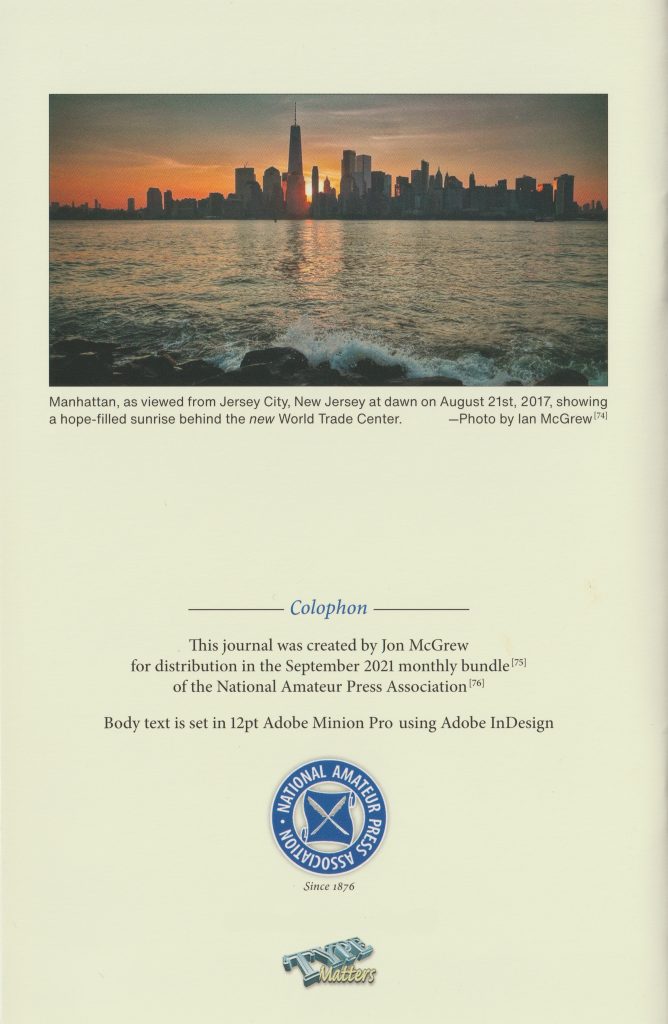
[74] Photo by Ian McGrew, Magoo Productions, Inc., https://www.ianmcgrew.com/
[75] The National Amateur Press Association, monthly bundle, https://amateurpress.org/the-monthly-bundles/
[76] The National Amateur Press Association, Established 1876, https://AmateurPress.org
Additional Reading:
“The 9/11 Commission Report,” https://www.govinfo.gov/content/pkg/GPO-911REPORT/pdf/GPO-911REPORT.pdf
“The 9/11 Commission Report, Executive Summary,” from the National Commission on Terrorist Attacks Upon the United States, https://govinfo.library.unt.edu/911/report/911Report_Exec.htm
“Never Forget the Heroes: Permanent Authorization of the September 11th Victim Compensation Fund Act,” 116thCongress, House of Representatives, 1st Session, Report 116-152, July 12, 2019, https://www.congress.gov/116/crpt/hrpt152/CRPT-116hrpt152.pdf
“The Environmental Impacts of the World Trade Center Attacks, A Preliminary Assessment,” Natural Resources Defense Council (NRDC), February 2002, https://www.nrdc.org/sites/default/files/wtc.pdf
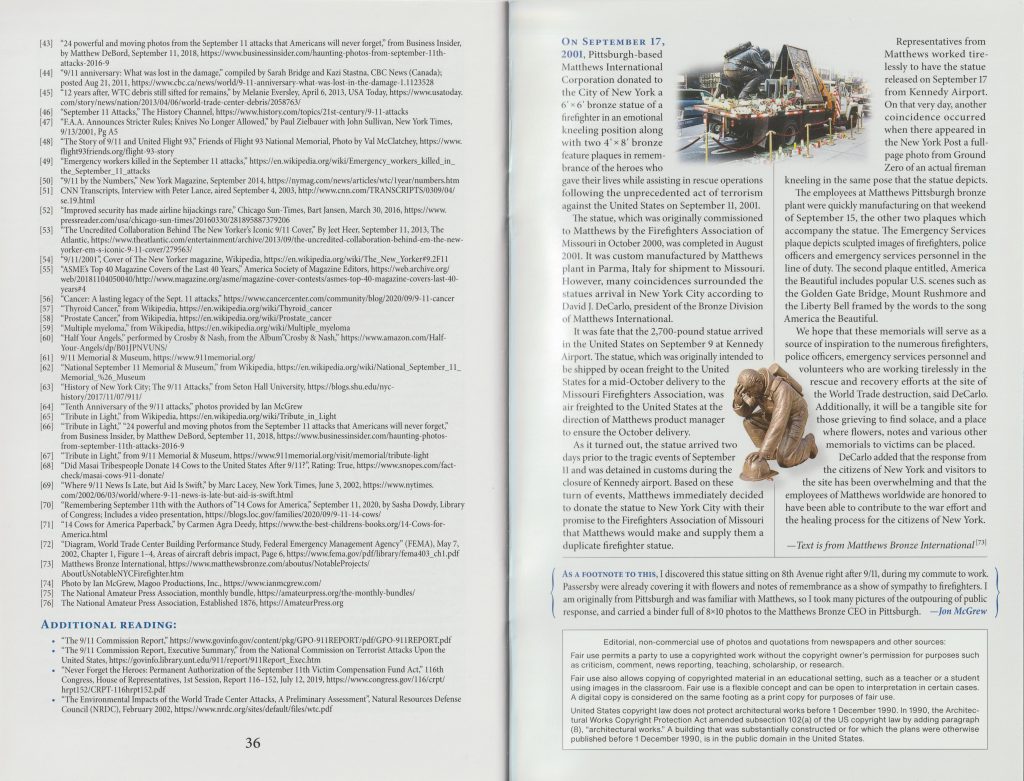
On September 17, 2001, Pittsburgh-based Matthews International Corporation donated to the City of New York a 6’ x 6’ bronze statue of a firefighter in an emotional kneeling position along with two 4’ x 8’ bronze feature plaques in remembrance of the heroes who gave their lives while assisting in rescue operations following the unprecedented act of terrorism against the United States on September 11, 2001.
The statue, which was originally commissioned to Matthews by the Firefighters Association of Missouri in October 2000, was completed in August 2001. It was custom manufactured by Matthews plant in Parma, Italy for shipment to Missouri. However, many coincidences surrounded the statues arrival in New York City according to David J. DeCarlo, president of the Bronze Division of Matthews International.
It was fate that the 2,700-pound statue arrived in the United States on September 9 at Kennedy Airport. The statue, which was originally intended to be shipped by ocean freight to the United States for a mid-October delivery to the Missouri Firefighters Association, was air freighted to the United States at the direction of Matthews product manager to ensure the October delivery.
As it turned out, the statue arrived two days prior to the tragic events of September 11 and was detained in customs during the closure of Kennedy airport. Based on these turn of events, Matthews immediately decided to donate the statue to New York City with their promise to the Firefighters Association of Missouri that Matthews would make and supply them a duplicate firefighter statue.
Representatives from Matthews worked tirelessly to have the statue released on September 17 from Kennedy Airport. On that very day, another coincidence occurred when there appeared in the New York Post a full-page photo from Ground Zero of an actual fireman kneeling in the same pose that the statue depicts.
The employees at Matthews Pittsburgh bronze plant were quickly manufacturing on that weekend of September 15, the other two plaques which accompany the statue. The Emergency Services plaque depicts sculpted images of firefighters, police officers and emergency services personnel in the line of duty. The second plaque entitled, America the Beautiful includes popular U.S. scenes such as the Golden Gate Bridge, Mount Rushmore and the Liberty Bell framed by the words to the song America the Beautiful.
We hope that these memorials will serve as a source of inspiration to the numerous firefighters, police officers, emergency services personnel and volunteers who are working tirelessly in the rescue and recovery efforts at the site of the World Trade destruction, said DeCarlo. Additionally, it will be a tangible site for those grieving to find solace, and a place where flowers, notes and various other memorials to victims can be placed.
DeCarlo added that the response from the citizens of New York and visitors to the site has been overwhelming and that the employees of Matthews worldwide are honored to have been able to contribute to the war effort and the healing process for the citizens of New York.
— Text is from Matthews Bronze International[73]
As a footnote to this, I discovered this statue sitting on 8th Avenue right after 9/11, during my commute to work. Passersby were already covering it with flowers and notes of remembrance as a show of sympathy to firefighters. I am originally from Pittsburgh, and was familiar with Matthews, so I took many pictures of the outpouring of public response, and carried a binder full of 8×10 photos to the Matthews Bronze CEO in Pittsburgh. – Jon McGrew
Editorial, non-commercial use of photos and quotations from newspapers and other sources:
Fair use permits a party to use a copyrighted work without the copyright owner’s permission for purposes such as criticism, comment, news reporting, teaching, scholarship, or research.
Fair use also allows copying of copyrighted material in an educational setting, such as a teacher or student using images in the classroom. Fair use is a flexible concept and can be open to interpretation in certain cases. A digital copy is considered on the same footing as a print copy for purposes of fair use.
United States copyright law does not protect architectural works before 1 December 1990. In 1990, the Architectural Works Copyright Protection Act amended subsection 102(a) of the US copyright law by adding paragraph (8), “architectural works.” A building that was substantially constructed or for which the plans were otherwise published before 1 December 1990, is in the public domain in the United States.
Picture Caption: Manhattan, as viewed from Jersey City, New Jersey at dawn on August 21st, 2017, showing a hope-filled sunrise behind the new World Trade Center. – Photo by Jon McGrew[74]
Colophon
This journal was created by Jon McGrew for distribution in the September 2001 monthly bundle[75] of the National Amateur Press Association[76]
Body text is set in 12pt Adobe Minion Pro using Adobe InDesign